
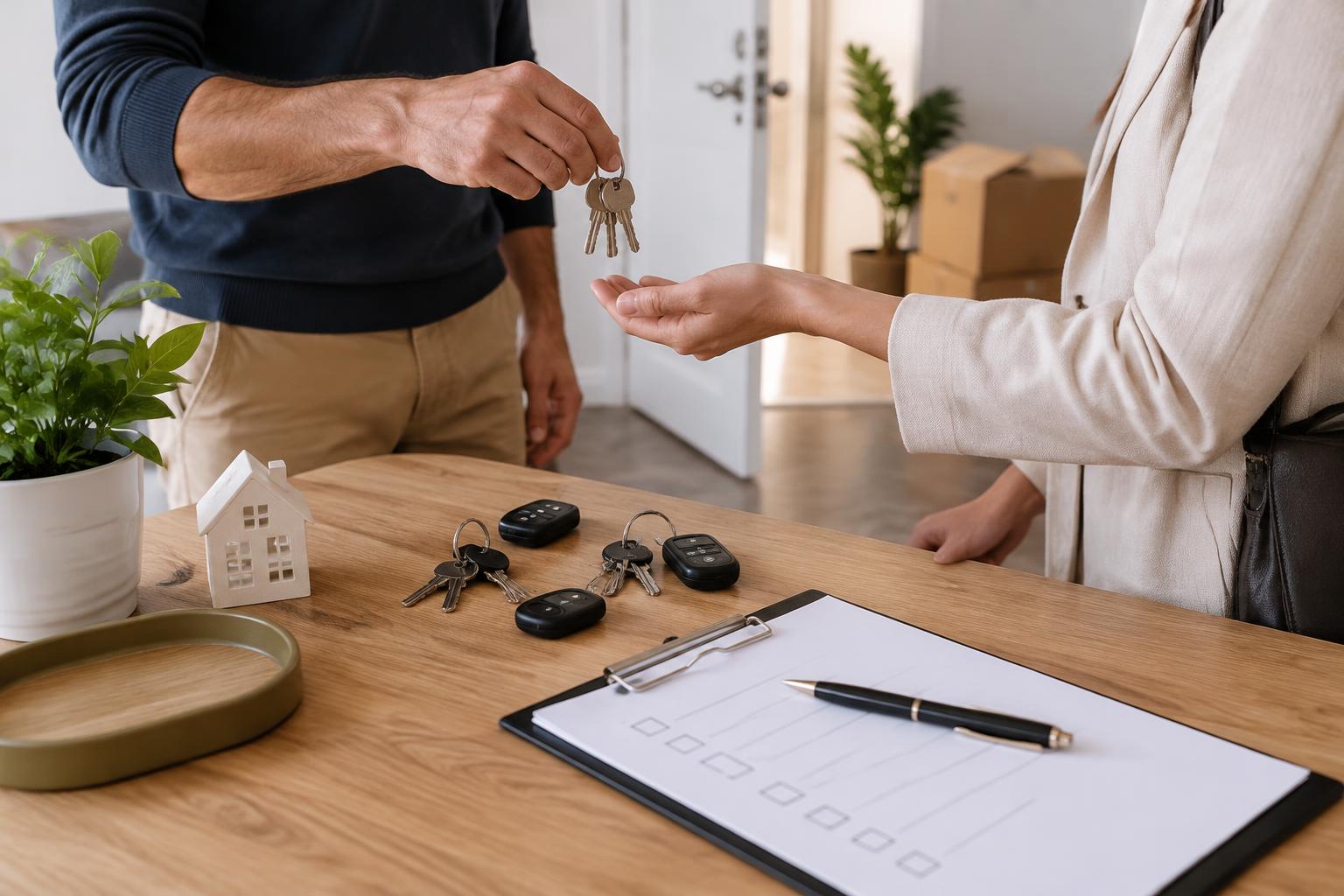
How to prepare the handover of keys for a sold property: inventory, remotes and receipt confirmation
Before completing a sale, it is advisable to prepare an orderly handover of the keys: which copies exist, which remotes are handed over, how to leave written confirmation of receipt and which documents it is advisable to sign to avoid later disagreements.
Why it is worth preparing the handover of keys in advance
The handover of the keys is not just a final gesture: it is the moment when it is worth clearly settling exactly what is being handed over and in what condition. If you are selling a property, this step helps to avoid claims about forgotten copies, garage remotes, storage room keys, access to communal areas or items that may have been left in the hands of third parties.
In addition, although the sale is formalised in a public deed, it is useful to leave practical confirmation of the material handover of possession and of the accessories that go with the property. This is especially relevant when the buyer needs to prove what they received and the seller wants to confirm that they handed over everything agreed.
In practice, the aim is simple: so that nobody has any doubt afterwards about whether a key was missing, a remote was returned or some copy was still in circulation.
What should be included in the inventory of keys, copies and remotes
Before the day of handover, prepare a brief but complete inventory. There is no need to turn it into a complex document; it should simply be precise and verifiable.
1. **Keys to access the property**: front door, internal doors if they form part of the agreed handover, letterbox and any additional lock.
2. **Existing copies**: how many copies you are handing over and, if you know, how many remain with other people for justified reasons, for example family members or support staff, provided this was envisaged.
3. **Remotes**: garage, gate, concierge, motorised blinds, access to the development or communal areas.
4. **Cards, electronic fobs or access devices**: not only physical keys; it is also advisable to list chips, key fobs, cards or coded remotes.
5. **Accessory items linked to possession**: for example, the garage identification tag or access credential, if there is one.
Practical tip: prepare the inventory in duplicate and mark each item with a number or a simple description. If there are two identical remotes, state this expressly so that the buyer does not receive “a remote” but “two remote controls model X”.
Common mistakes:
- Handing over “the keys” without specifying how many or which ones.
- Forgetting garage remotes or access to communal areas.
- Not checking whether copies are in the hands of third parties.
- Leaving it until the end to return cards, fobs or storage room keys.
How to provide useful confirmation of receipt
Confirmation of receipt is the most important part for avoiding later disputes. It should be clear that the buyer has received what is described in the inventory and that you, as the seller, have handed it over.
The most practical formula is a **handover document for keys and accessories** signed by both parties at the same time as the signing, or at an immediately following time agreed in writing. That document should include, as a minimum:
- Identification of seller and buyer.
- Property address.
- List of keys, copies, remotes, cards and other accessories.
- A declaration that the buyer receives them to their satisfaction or with any reservations they wish to note.
- Signature of both parties.
The Horizontal Property Act requires certain communications to the community to be made by a means that allows receipt to be confirmed; in addition, the change of ownership must be communicated to the person carrying out the functions of secretary by a means that allows receipt to be confirmed. This reinforces the need to document the practical transfer of the property and its access devices as well. The rule itself says that the owner must notify the change of ownership “by any means that allows confirmation of receipt” and that, if this is not done, they may continue to be liable in the terms provided for by law. You can check this in the extract from article 9 of the Horizontal Property Act: “**Communicate to whoever performs the functions of secretary of the community, by any means that allows confirmation of receipt, the change of ownership of the dwelling or premises.**”
What steps to follow on the day of handover
Doing it properly does not require complexity, but it does require order. A useful sequence would be this:
1. **Check the inventory before leaving home** and make sure each item is physically available.
2. **Group keys and remotes into sets**: property, letterbox, garage, storage room, communal areas.
3. **Check consistency with the deed or private agreement** if any specific accessory was mentioned there.
4. **Sign the handover document** at the same time as the physical handover is made.
5. **Give a copy to each party** and keep a signed version in your records.
6. **If you detect that something is missing**, note the issue in writing in the document itself before signing it.
Tip: if the property has several access points or shared items, do a brief final check with the buyer present. That joint check usually avoids misunderstandings such as “I thought that remote was included too”.
What to do with pending copies or shared access
Sometimes not all copies are in the property at the time of the sale. There may be a copy in a maintenance office, with a relative, with a trusted neighbour or in the hands of a person who assisted during the previous period. In those cases, the important thing is not to leave it implied.
If there are copies that are not being handed over, it is advisable to distinguish between:
- **Copies handed over on the day**.
- **Copies collected later** and when.
- **Copies whose whereabouts are unclear**, which should be clarified before signing.
If the property belongs to a community with common elements, remember that the Horizontal Property Act regulates contributions to common expenses and the communication of ownership. It is also useful that, after the sale, the buyer has the correct contacts to manage duplicates, cards or access arrangements that depend on the community, not on the seller.
Practical model for confirmation of receipt
Without turning it into a new contract, you can include a simple clause such as this:
- “The buyer declares that they receive at this act the keys, remotes, cards and other accessories listed in the attached inventory, in number and condition in accordance with what is indicated.”
If there is any reservation, it is advisable to add it immediately:
- “Delivery remains pending of the remote identified as…, which will be delivered on…”
In this way, the document serves to record both what has been handed over and what remains pending, if anything.
When to seek professional help
For a straightforward handover, you can prepare this closing yourself. However, if the property has many access points, if there are tenants, if the community uses electronic systems, or if there is any dispute about which accessories really belong to the sale, it is advisable to review the case individually.
If you would like an indicative valuation of your property or to coordinate the completion of the sale with an orderly handover, you can use the online property valuation in Madrid page or contact UBICASA via contact. The online estimate is indicative, does not constitute an official valuation, and includes a price range and a PDF report, with an optional visit if a more precise analysis is needed.
In any case, the best approach is to set out the essentials in writing: what is being handed over, how many units there are, who receives them and on what date. That simple confirmation usually saves problems long after the sale has been signed.
Remove belongings and document the condition
Walk through each room and remove personal items that are not included in the agreement. Keep dated photographs of the rooms, the included equipment and meter readings, without capturing documents or private data. Share the inventory with the buyer to identify any discrepancies before handing over the property.
Review all copies of the keys
Include in the inventory copies of the entrance door, the property, the garage and the storage room. Ask for the return of any copies kept by former occupants or authorised persons. If you do not know how many copies exist, discuss it with the buyer and agree the necessary security measures.