
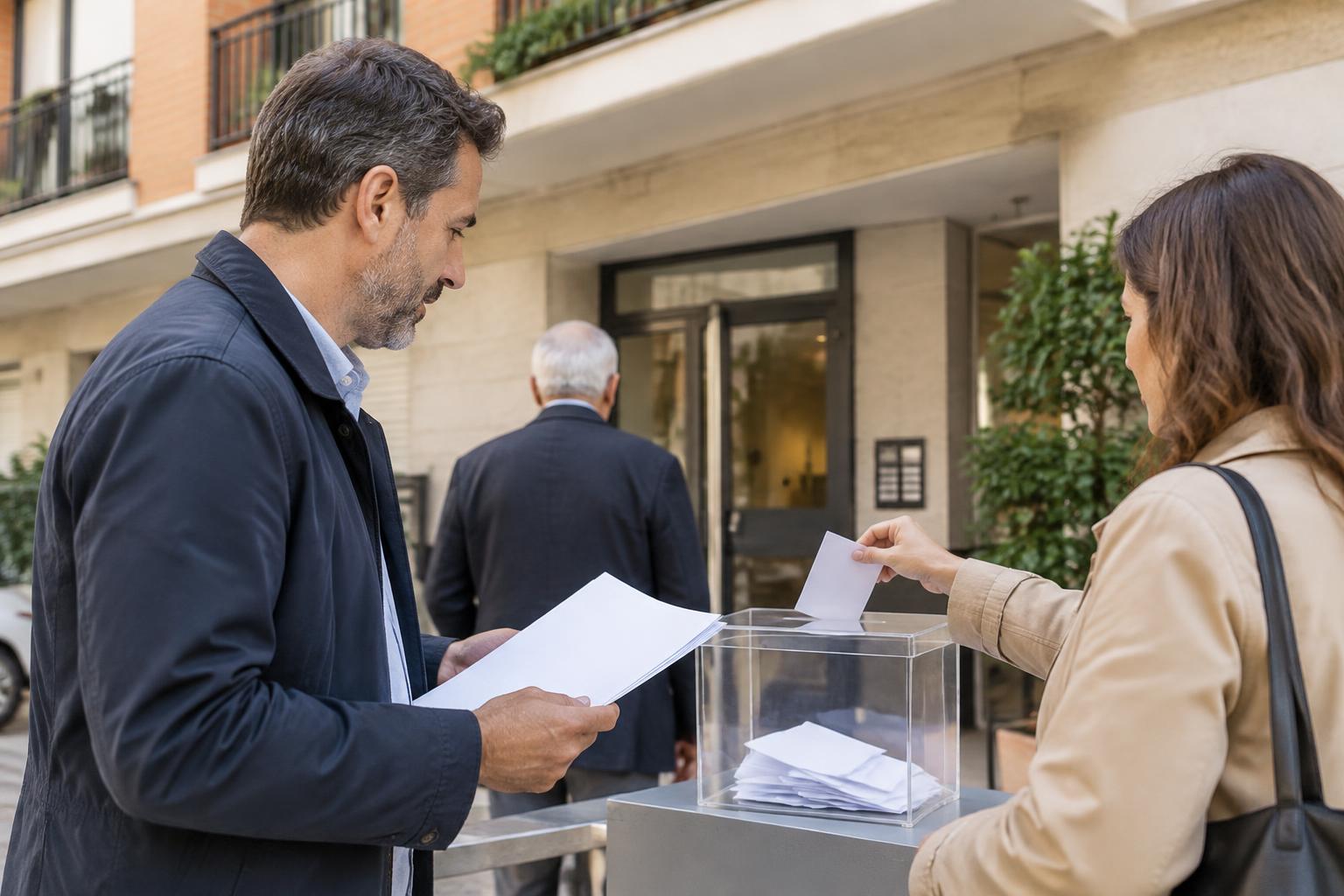
Right to vote in the owners’ association: what to check if you have debts
When an owner has overdue community fees, they do not always lose their voice at the meeting, but they may be unable to vote if they are not up to date and have not challenged the debt or paid it into court or before a notary. This guide explains what to check in Article 15 of the LPH, what exceptions exist and what practical steps are advisable before the meeting.
What happens to your vote if you have debts with the community
If you attend an owners’ meeting with overdue amounts still unpaid, the general rule is clear: you may take part in the discussions, but you may lose the right to vote. This is set out in Article 15.2 of the Ley de Propiedad Horizontal, which also provides an important exception: if you have challenged the debt in court or have made a judicial or notarial payment into escrow of the amount owed, that loss of voting rights does not apply. The rule itself also states that the minutes must record the owners deprived of voting rights and that neither their person nor their share will be counted towards the required majorities.
The logic behind this rule is practical: the community may hear from you, but it does not want someone with overdue debts to influence the outcome of decisions while they have not regularised their position or have not used the avenues provided by law. This general guidance must always be read carefully, because it depends on specific facts: what debt exists, whether it is overdue, whether it has been challenged, whether it has been paid into court or before a notary and when the meeting begins.
What to check before the meeting if you are in this situation
Before attending, it is worth checking these points in order:
1. **Whether the debt is truly overdue.** A verbal disagreement or an invoice you believe is incorrect is not enough. The loss of voting rights is linked to overdue debts with the community.
2. **Whether you have challenged the debt in court.** Article 15.2 requires that such a challenge exists; it is not enough to have sent an email, a complaint or an informal request.
3. **Whether you have paid the amount owed into court or before a notary.** The payment into escrow must be genuine and capable of being evidenced. If you intend to attend the meeting arguing that you retain voting rights by this route, it is important to have the receipt ready.
4. **Whether the notice identifies you as a debtor.** Article 16.2 states that the notice must include the list of owners who are not up to date and warn of the loss of voting rights if the circumstances in Article 15.2 apply.
5. **Whether the meeting starts once your situation has been regularised.** The legal key point is the moment the meeting begins, not when the dispute arose.
For an indicative check of your property’s value, you can use this internal UBICASA service: nuestra valoración de vivienda en Madrid. The online estimate is indicative, includes a range and PDF report, and can be supplemented with an optional visit.
Exceptions you should bear in mind
Not all debt cases have the same effect. There are three aspects you should distinguish:
- **Disagreement without challenge or payment into escrow:** if you merely dispute the debt, but have not challenged it in court or paid it into escrow, you may attend the meeting but not vote.
- **Effective challenge or payment into escrow:** in these cases, Article 15.2 opens the door to retaining the right to vote.
- **Debt that is not for overdue community fees:** if the amount does not fit that definition, the situation may require a different individual assessment.
This is important because, in practice, some communities confuse a pending claim with an overdue debt that has not been challenged in court. That confusion can lead to mistakes in the minutes or in the calculation of majorities.
What you should do to avoid mistakes
If you think there may be doubts about your vote, these steps will help you keep the situation in order:
1. **Gather proof of payment.** If you have paid, keep bank receipts, slips and any communication proving it.
2. **Check whether there is a payment into escrow.** If you do not want to be deprived of the vote, judicial or notarial payment into escrow is a route expressly mentioned by law.
3. **Review the notice.** If you are included as a debtor, check that the community has correctly reflected your situation.
4. **Ask for your position to be recorded.** Even if you cannot vote, you may take part in the discussions and it is advisable for your intervention to be clearly recorded.
5. **Request a copy of the minutes once approved.** The minutes must identify the owners deprived of the vote; if you believe there is an error, that document will be key to assessing it.
Common mistakes to avoid
- **Thinking that simply objecting verbally means you keep the vote.** The law requires a judicial challenge or payment into escrow.
- **Leaving payment until the same day without checking whether the overdue debt is already on record.** The relevant moment is the start of the meeting.
- **Confusing attendance with the right to vote.** You may attend and speak, but not always vote.
- **Not checking the minutes.** If you are wrongly deprived of the vote, the minutes should make it possible to detect that problem.
- **Ignoring the link between debt and majorities.** Neither the person nor their share counts towards the required majorities, which may alter the outcome of the decision.
How to act if the community deprives you of your vote
If you believe the community has applied Article 15 incorrectly, the answer is not to improvise at the meeting, but to organise the paperwork properly. At the same time, check whether there is a real overdue debt, whether there was a valid payment into escrow or whether the judicial challenge was lodged correctly. The law also allows owners to challenge decisions of the meeting, but for that Article 18.2 requires that you be up to date with payment of all overdue debts or that you previously make a judicial payment into escrow, except in the case of decisions on participation shares.
That is why, if the dispute is not only about the vote but about a decision adopted, you must distinguish two levels: your participation in the meeting and any later challenge.
When to seek help and what information to have ready
If the situation is not clear, it is worth having to hand:
- notice of the meeting;
- proof of payment;
- communications with the administrator or secretary;
- a copy of any payment into escrow;
- the exact reference of the debt claimed;
- the minutes of the meeting, once available.
If you want to resolve doubts about your specific case or need support reviewing the paperwork, you can contact UBICASA at nuestra página de contacto. The office is at Calle Montesa 29, Madrid, and is open Monday to Friday from 10:00 to 15:00 and from 16:00 to 19:00.
On the regulatory side, the applicable rule is summed up in the LPH: "Los propietarios que en el momento de iniciarse la junta no se encontrasen al corriente en el pago de todas las deudas vencidas con la comunidad y no hubiesen impugnado judicialmente las mismas o procedido a la consignación judicial o notarial de la suma adeudada, podrán participar en sus deliberaciones si bien no tendrán derecho de voto." Ley 49/1960, art. 15.2
Practical summary
If you have debts with the community, the essential thing is to check three things: whether the debt is overdue, whether you have challenged it in court and whether you have paid the amount owed into escrow. Without one of those last two routes, you may attend and speak, but not vote. In addition, the notice must warn of that possible loss of voting rights and the minutes must record the owners without a vote. If there is real doubt, do not improvise: document everything and, if necessary, ask for an individual review of the case.