
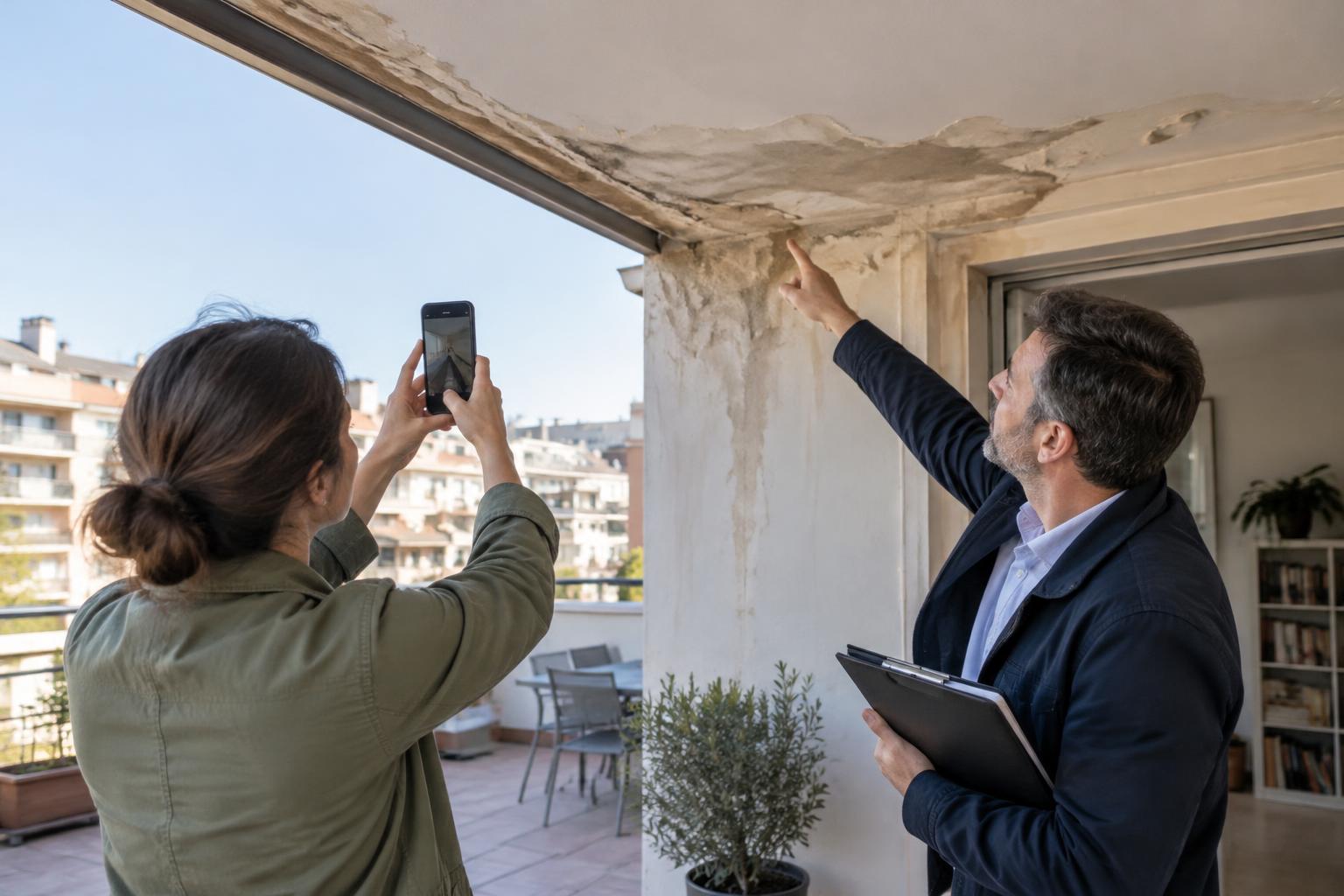
Terrace leakages: how to document the source and coordinate repairs
When damp patches or leaks appear on a terrace, the most useful thing is to organise evidence, distinguish which part may be private and which common, and coordinate the repair without jumping to blame. This guide explains how to act in a community of owners under the LPH, with practical criteria for documentation and communication.
What to do first when you spot leaks on a terrace
When stains, leaks or damp patches appear from a terrace, the most important thing is not to argue immediately over whose fault it is, but to **keep an orderly record of what is happening**. In horizontal property, a terrace may include private and common elements, and that distinction is not always obvious at first glance. It is therefore worth acting methodically from the outset.
Under the Ley de Propiedad Horizontal, the owner must keep their flat or premises and private installations in good condition, but must also **consent to any repairs required for the service of the property** and allow the necessary easements to carry them out. In addition, the community must take care of maintenance and urgent repairs where these relate to common elements. In practical terms, this means the first question is not only “who owns the terrace?”, but “which exact part is failing?”.
Recommended initial steps:
1. **Take photos as soon as possible** of the visible damage: stains, flaking plaster, damp, puddles, cracks, open joints or any sign on ceilings, walls and flooring.
2. **Note the date and time** it was detected, when it first appeared and whether the damage changes with rain.
3. **Record a short video** if the leak is active, to show where the water is entering or how it spreads.
4. **Keep messages and notices** sent to the president, administrator or affected neighbour.
5. **Avoid touching the damaged area** until there is a diagnosis, except to minimise immediate damage.
How to document the source without assigning blame
Documenting the source does not mean proving legal liability definitively. It means gathering useful elements so that the community, the affected owner or the technician can identify the point where the water is entering. If there is no expert report yet, it is wise to talk about **indications**, not conclusions.
The most useful documentation is usually as follows:
- **Comparative photographic record**: general images of the terrace and close-ups of joints, drains, junctions with parapets, drip edges, cracks and outlets.
- **Photos of the affected interior**: ceilings, walls, cupboards or flooring where traces of water can be seen.
- **Simple sketch** or plan with arrows showing where the water seems to be travelling.
- **History of incidents**: whether the stain appears only when it rains, whether it coincides with wind, whether it worsens after cleaning drains, or whether it is constant.
- **Copies of communications** with the community and with neighbouring owners if there is shared impact.
Messages should be worded cautiously. It is better to write “water ingress can be seen at this point” than “the waterproofing is badly done” or “the neighbour caused the damage”. Without expert evidence, a categorical statement can create unnecessary conflict and hinder coordination.
Practical tips:
- Take photos **before cleaning or drying** the area, because afterwards the clues may be lost.
- Include **visual references**: a ruler, a coin or a small object can help show the size of a crack, without needing complex technical measurements.
- Ask another person to take images too if two homes are affected; that way you will have a second version of the same incident.
- Keep a file organised by date; in leakage cases, chronological order is often as important as image quality.
Private terrace, common element and exclusive use: why the distinction matters
In a community, the word “terrace” is not enough to know who should act. It may be:
- a **private terrace** integrated into the dwelling;
- a **common element for private or exclusive use**;
- or a part that, even if used by one owner, also serves as a roof, water drainage or building protection.
The LPH distinguishes between the individual right over the private space and the co-ownership of common elements. It also allows the constitutive title and the bylaws to specify uses, maintenance and repairs. That is why, before deciding who pays, the property documentation must be checked.
### What to review before requesting the repair
1. **Deed and constitutive title**: to see whether the terrace is listed as an annex, private element or common space.
2. **Community bylaws**: these may clarify the rules on use, maintenance or enclosures.
3. **Previous minutes**: sometimes the community has already dealt with a similar issue and agreed how to divide the work.
4. **Building log book or available technical documentation**: useful to understand whether the terrace functions as a roof or protection for the property.
5. **Actual state of the area**: the same terrace may have private flooring, but common waterproofing.
A common mistake is to assume that, because it is on the top floor or for exclusive use, everything automatically falls to the owner who uses it. That is not always the case. Nor is the opposite true: that everything on a terrace is common simply because it is outdoors. The solution depends on the specific legal and technical configuration.
How to coordinate the repair with the community
Once the indications have been gathered, the advisable course is to **open a clear line of coordination** with the president or the administrator. If the damage affects common areas, if a possible roof is involved or if the leak affects several homes, the community should become involved in the management as soon as possible.
The LPH assigns the administrator the function of **attending to the upkeep and maintenance of the property, arranging urgent repairs and measures**, and reporting immediately to the president or the owners. It also assigns the Board the approval of repair works on the property and information on the urgent measures adopted. This sets out the practical sequence: first locate the problem, then decide on the intervention and finally record the agreement or action.
### A useful coordination proposal
1. **Formal written notice** to the president and administrator, with photos and an objective description.
2. **Request for a technical inspection** of the affected area to identify the exact source.
3. **Opening up necessary access** to the terrace or affected homes if junctions, drains or walls need to be checked.
4. **Quote or valuation of the work** if the community needs to commission repairs.
5. **Record of the agreement** in the minutes or in internal communication, to avoid later doubt.
If the source is still unclear, it is preferable to agree a **technical review** before apportioning responsibility. This avoids one party paying costs that may not be theirs, or an urgent repair being held up by arguments over blame.
What not to do before a diagnosis
There are mistakes that often make these cases much more complicated:
- **Not taking photos of the initial condition** and relying only on a verbal explanation.
- **Patching, chiselling or lifting areas** on your own without notice, because relevant evidence may be lost.
- **Assigning blame without a technical report**.
- **Delaying the notice** while hoping the leak will sort itself out.
- **Confusing urgency with final allocation of costs**: an immediate intervention does not always clarify who will ultimately bear the expense.
If you need help organising the documentation or passing the matter on to the community, you can use our contact at /contacto. If you would also like an approximate reference for the value of your home, you can use the online estimate at /valoracion-vivienda-madrid; it is indicative, does not replace an official valuation, and includes a price range and PDF report with an optional visit.
If you have any doubt about the legal status of the terrace or about how to prepare the communication to the community, the prudent approach is to request an individual review of the case, because the answer depends on the title, the bylaws and the specific damage. This guide offers general guidance, not personalised legal advice.