
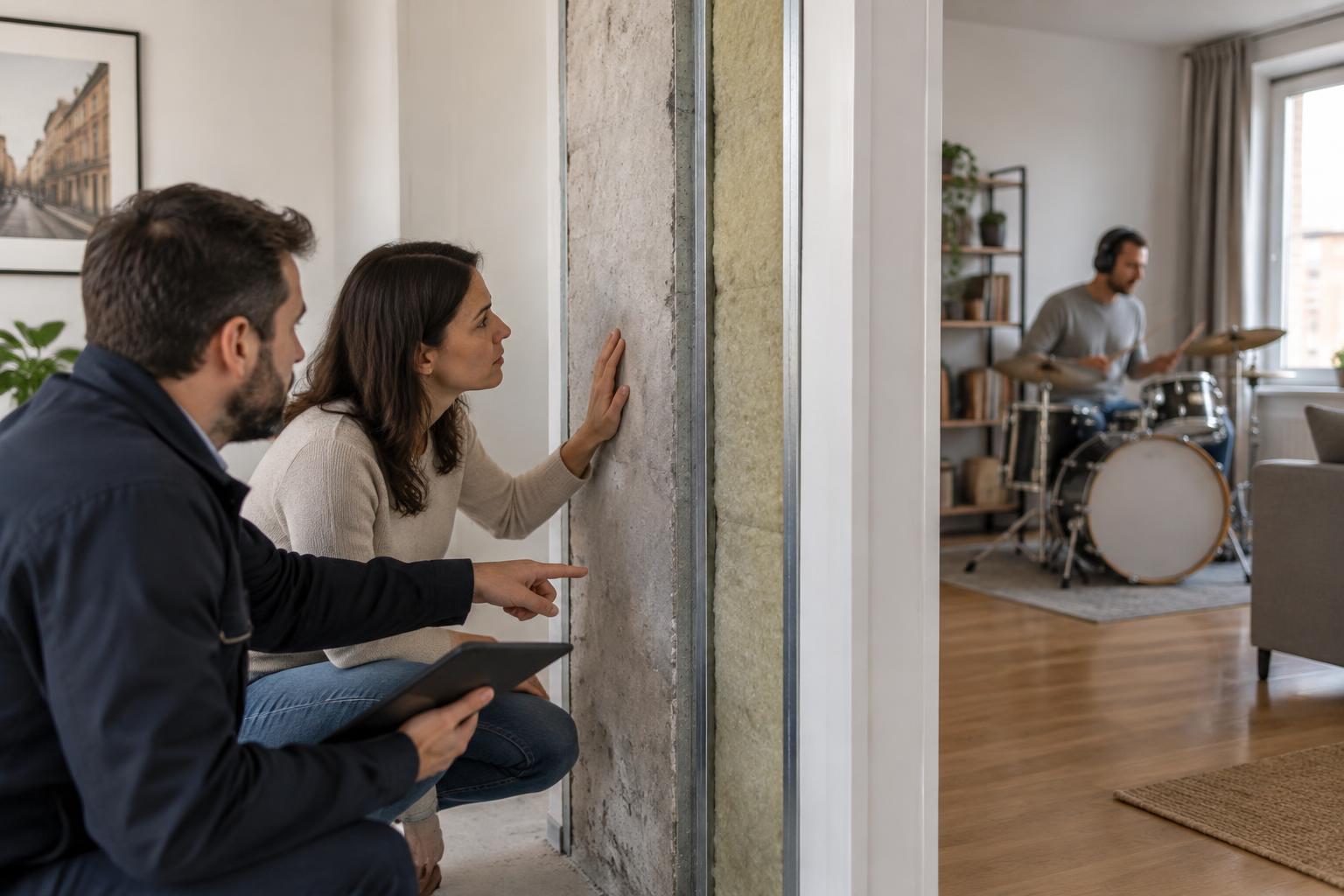
Acoustic insulation for a flat: what to check before starting work
Before renovating to improve acoustic insulation, it is worth identifying the real source of the noise, checking which elements you may alter and what permissions you may need from the building community. A well-planned project will not guarantee total silence, but it can avoid costly mistakes and unnecessary disputes.
Acoustic insulation for a flat: what to check before starting work
When an owner is thinking about improving the acoustic insulation of their flat, the first step should not be choosing materials, but understanding where the noise is coming from and what can be intervened on without creating technical or community problems. In residential property, sound can enter through several points at once: party walls, slabs, ceilings, window openings, doors, service ducts or installations. If the source is not properly diagnosed, it is easy to spend money on work that improves very little or only solves part of the problem.
In addition, in a building under horizontal property ownership, not every action is the same. The Horizontal Property Act allows the owner to modify architectural elements, installations or services in their home, but within clear limits: they must not impair the safety, structure, external appearance or condition of the building, nor prejudice the rights of another owner, and they must give prior notice of the works to whoever represents the community. It is also worth remembering that activities that are disturbing or that contravene the general rules on disturbing, unhealthy, harmful, dangerous or unlawful activities cannot be carried out. You can see this in Ley 49/1960, de propiedad horizontal, article 7 and in the same text regarding articles 9, 10 and 17.
1. First: identify the real source of the noise
Before drawing up a project, carry out a basic check of the problem. Not all noise is tackled in the same way.
1. **Airborne noise**: voices, television, music, traffic, barking dogs. It usually enters through façades, windows, shutter boxes, joints or lightweight partitions.
2. **Impact noise**: footsteps, moving furniture, objects dropping. It is usually transmitted through slabs, floors and ceilings.
3. **Installation noise**: downpipes, drains, lifts, booster pumps, air conditioning units. It may come from service ducts, junctions and common elements.
4. **Acoustic bridges**: weak points where sound “jumps” the main enclosure, for example shutter boxes, service openings, sockets, poorly resolved false ceilings or junctions between materials.
**Practical tip:** note when you hear the noise most, from which room and how intense it seems. That information is very helpful for the technician.
**Common mistake:** ordering an internal lining when the noise is actually entering through the window or a downpipe. In that case, the work may leave the problem almost unchanged.
2. Get a professional diagnosis before breaking anything
A serious acoustic improvement requires diagnosis. A subjective impression is not enough, because two different noises can feel similar. A specialist technician can inspect the enclosure, junctions, openings and transmission through the structure to propose a tailored solution.
In practice, that diagnosis should help answer specific questions:
- Is the main problem in the façade, the partition wall, the ceiling or the floor?
- Are common elements involved?
- Does the solution require action from inside the home or also on parts of the building?
- Will the planned improvement affect installations, ventilation, access points or maintenance?
If you wish, you can use an online indicative valuation of a home in Madrid. It does not replace an official valuation, but it can help you organise the decision before a renovation. If you would prefer to discuss it in detail, you can also do so via contact.
**Practical tip:** ask the professional to explain the solution in layers: what is being corrected, why, where the sound is being lost and what the limits of the intervention are.
**Common mistake:** accepting an all-purpose proposal without checking whether the noise is airborne or impact noise. The result is usually a poorly targeted budget and unrealistic expectations.
3. Check whether the work affects private or common elements
This is one of the most important checks. Changing an internal finish is not the same as intervening on a common element or on something that affects the building.
The Horizontal Property Act distinguishes between the owner’s power to alter their flat and the obligation not to harm the community or the other owners. In addition, the Owners’ Meeting has powers to approve budgets and the execution of repair works on the building, as well as to decide on matters of general interest. Article 10 also provides for mandatory actions in certain cases and article 17 governs the majorities and agreements for different types of works and improvements. The consolidated text of the law includes, among other points, that works necessary for proper maintenance and conservation may be mandatory, and that certain innovations or improvements require specific majorities.
In an acoustic renovation, this means you should check whether your idea affects:
- slabs or structural elements,
- façades or external joinery,
- downpipes, service ducts or common installations,
- ventilation and hygiene,
- the building’s external appearance,
- or private areas without impact on third parties.
**Practical tip:** before finalising the project, ask for a written breakdown of which part is carried out inside your home and which part, if any, affects common elements or requires community approval.
**Common mistake:** starting work on the assumption that everything “inside the flat” is always private. In a building community, that idea can fail if the work affects common elements or the building as a whole.
4. Check permits, notices and paperwork
Not all acoustic insulation works require the same procedure, but it is worth reviewing the paperwork before starting. If the work is substantial, it may require prior notice to the community and, where appropriate, agreement if it affects elements or rules subject to the Owners’ Meeting. The law itself provides that the owner must give prior notice of works that may affect the community.
It is helpful to organise this part in a list:
1. **Technical note or explanation of the intervention.**
2. **Plan or detail of what will be altered.**
3. **Confirmation of whether it affects common elements.**
4. **Notice to the community or authorisation, if applicable.**
5. **Coordination with the property manager or president to avoid conflicts over access, building work noise or incidents in communal areas.**
If the work may cause disturbance, plan how it will be carried out: hours, waste removal, protection of communal areas and access to the property.
**Practical tip:** keep all communications in writing. If a dispute later arises about the work, it will help to have a clear record of what was reported and what was approved.
**Common mistake:** relying on a verbal reply from a neighbour or the president without keeping any record. In a renovation, good intentions do not replace documentary proof.
5. Do not expect absolute silence: set the real objective
An acoustic renovation can significantly improve comfort, but it does not guarantee total silence. The result depends on the source of the noise, the type of building, the continuity of the enclosures and the quality of the workmanship. If the problem comes from several sources, it may be necessary to combine solutions: window, lining, floating floor, sealing joints or treating installations.
**What you should be clear about before hiring someone:**
- exactly what noise you want to reduce,
- what level of improvement is reasonable to expect,
- which part of the problem will remain,
- and what maintenance or limitations the solution will have.
**Practical tip:** first consider the measures with the best balance between impact and technical complexity. Sometimes a poorly resolved window generates more noise than the rest of the enclosure put together.
**Common mistake:** asking for work “to soundproof” without specifying the objective. Reducing the neighbour’s conversations is not the same as damping impact sounds or vibrations from installations.
In summary
Before carrying out acoustic insulation works in a flat, the key is to diagnose the source of the noise properly, check whether the intervention affects only your home or also common elements, and review whether the work needs to be communicated to or approved by the community. The Horizontal Property Act recognises the owner’s scope of action, but it also imposes limits and co-existence rules that are worth respecting from the outset.
If you want to make a safer decision, do not start with the material: start with the diagnosis. That is the step that most helps you avoid pointless works, neighbour disputes and false expectations about final silence. For an initial indication, you can use the online valuation or write to us via contact.