
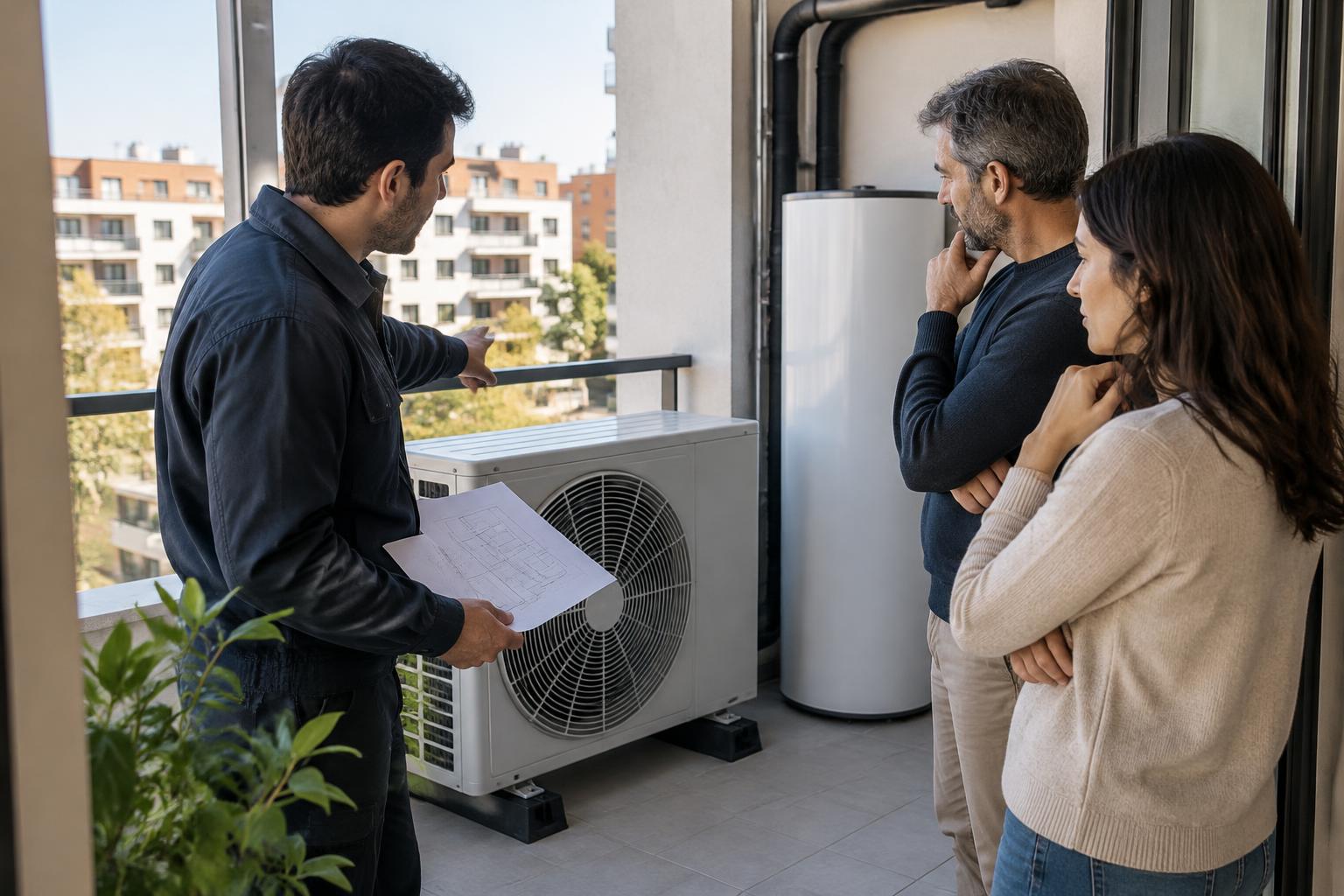
Aerothermal heating in a flat: what to check before installing it
Before installing aerothermal heating in a flat, it is advisable to check the available space, technical feasibility, impact on common elements, and the community’s by-laws and agreements. This guide helps you identify the key points before requesting quotes or starting work.
Aerothermal heating in a flat: what to check before installing it
Installing aerothermal heating in a flat is not just a matter of choosing a unit and finding somewhere to put it. In a property under horizontal ownership, the decision can sometimes affect the terrace, façade, patios, roofs, downpipes, ducts or even common elements of the building. That is why, before moving ahead, it is worth carefully checking what can be done within your home and what requires authorisation or coordination with the community.
The Ley de Propiedad Horizontal distinguishes between what the owner may alter within their flat and what may affect the building or other owners. In particular, article 7 allows the owner to modify elements, installations or services within their flat provided this does not undermine the safety, structure, configuration or external appearance of the building, or harm the rights of other owners, and requires them to notify the person representing the community in advance. In addition, article 17 regulates agreements on renewable energy, including aerothermal and geothermal systems, with specific majorities depending on the type of work.
1. First check whether there is really space for the system
Aerothermal heating in a flat usually requires an outdoor unit, an indoor unit or hydro kit, pipework, space for maintenance and, in some cases, compatibility with the existing installation. Before talking about permissions, make an honest check of the available space.
### What to check
1. **Where the outdoor unit would go**: terrace, private-use patio, roof or façade are not the same. Occupying a private space is not the same as fixing a unit to a common element.
2. **Whether there is enough height, ventilation and maintenance access**: a poorly placed unit can make cleaning, inspections and future repairs difficult.
3. **Whether the home has enough indoor space** for the hydraulic section or the technical support required.
4. **Whether the installation will require pipes or ducts** to run through common areas or neighbouring homes.
5. **Whether it will be necessary to drill through slabs, load-bearing walls, enclosures or joinery**.
### Practical advice
Ask the technician for a preliminary visit and a proposed location before making decisions. Do not settle for a “standard” solution if your flat has special features: a penthouse, internal flat, attic conversion, home with a enclosed terrace or flat with exclusive-use patio can all present very different scenarios.
### Common mistake
Thinking that, because it is an improvement within your home, there is no need to check the building. In aerothermal heating, the critical point is not just the appliance, but where it is installed and what it affects around it.
2. Check whether the installation affects common elements or the façade
In a community of owners, the boundary between private and common elements is essential. If the installation involves working on the façade, common patio, roof, structure or elements visible from the outside, the analysis changes.
Article 7 of the Ley de Propiedad Horizontal states that the general safety, structure, external appearance or overall condition of the building may not be altered, nor the rights of another owner harmed. Meanwhile, article 17.1 provides that the installation of common infrastructure for access to collective energy services and the installation of renewable energy systems, including aerothermal and geothermal systems, may be approved by one third of the members of the community representing one third of the participation quotas, with the distribution rules set out there.
### Questions to ask yourself
1. Will the outdoor unit be placed in a private-use area or on a common element?
2. Will it be visible from the street or alter the building’s appearance?
3. Will it cause noise, vibrations or disturbance to neighbouring residents?
4. Will cables, pipes or drainage need to pass through common areas?
5. Do the community by-laws expressly restrict this type of installation?
### Practical action
Before commissioning the work, ask the technician to provide a written description of the exact location of the equipment, the route of the installation and the fixing points. That information will help you present it to the community if needed and avoid later disputes.
3. Check what permission you need from the community
Not all aerothermal installations require the same community procedure. The key is to know whether the work is purely private or whether it involves common elements, a shared energy improvement or a significant alteration to the building.
According to article 17 of the Ley de Propiedad Horizontal, certain renewable energy installations may be adopted by a one-third majority; other energy-efficiency or accessibility improvements may require different majorities depending on the case. In addition, article 18 regulates challenges to agreements that are contrary to the law or the by-laws, which makes it important that the approval procedure is properly documented.
### How to proceed
1. **Check the by-laws, title deed and internal rules**.
2. **Identify whether the work occupies, alters or uses a common element**.
3. **Submit a clear proposal to the community** with location, visual impact, expected noise and the route of the installation.
4. **Ask for the agreement to be recorded in the minutes**.
5. **Do not start the work if there is any doubt about authorisation**.
### Common mistake
Relying on an informal approval from neighbours or the president without checking whether the agreement meets the required majority or whether advance notification was actually sufficient. In a community, form matters just as much as substance.
4. Require a professional technical review before contracting
For an aerothermal installation in a flat, the technical review is not a formality: it is what prevents incompatibilities with the home and the building.
### What that review should include
1. Condition of the electrical installation and supply capacity.
2. Compatibility with radiators, underfloor heating, fan coils or other emitters.
3. Available space for equipment and access panels.
4. Possible noise and vibration issues.
5. Need for work on enclosures, patios or ceilings.
6. Possible temporary easements during the works.
### Practical advice
Ask them to explain not only **whether it fits**, but **how the system will be maintained and repaired**. An unit that just about fits but cannot be properly accessed ends up causing usage and community problems.
### Practical action
Keep the technical specification, plans, equipment data sheets and, where applicable, the community notification or agreement. If you sell the home in the future, this documentation can help explain the work and avoid buyer concerns. If you would like an indicative valuation of your flat in Madrid, you can use this tool; if you would rather discuss your case, you can write from /contacto.
5. Do not confuse energy improvement with automatic authorisation
The fact that an installation has an energy-related purpose does not mean that everything is automatically allowed. In a home within a community, the installation must be compatible with horizontal property law, the by-laws and the rights of the other co-owners.
The LPH expressly covers renewable energy systems, including aerothermal and geothermal systems, but this does not remove the need to assess the physical support of the installation, the occupation of common spaces and the way it is approved. In addition, the building must still be properly maintained and works must not harm safety or structure.
### Final checklist before installing
1. Is there real, accessible physical space?
2. Does the location affect the façade, roof, patio or structure?
3. Do you need community approval and what majority would apply?
4. Is the technical proposal clear and in writing?
5. Can the installation be carried out without harming other neighbours?
6. Have you checked the by-laws and title deed?
### Mistakes to avoid
- Starting by buying the equipment before knowing whether it will fit.
- Assuming that a private-use terrace allows any fixing or external outlet.
- Forgetting that noise and vibrations also create community disputes.
- Failing to document the approval or notification to the community.
- Relying on improvised solutions for running pipes or drainage.
In short, before installing aerothermal heating in a flat, the important thing is not just the technology, but the compatibility between the home, the building and the community. If you review it in that order — space, technical impact, permissions and documentation — you will reduce risks and make a more solid decision for your property.