
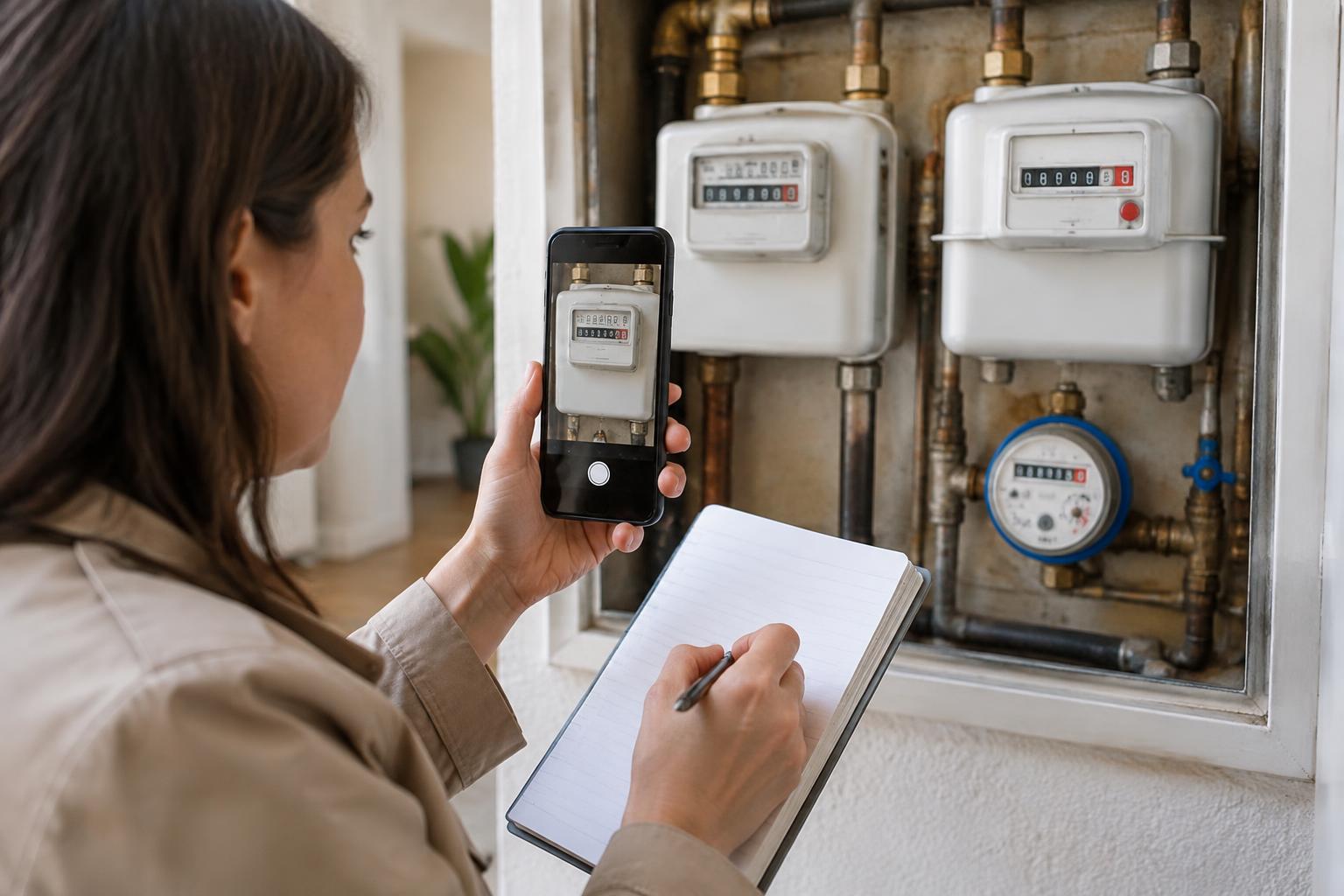
How to document meter readings when handing over a house
When handing over a property, clearly recording the electricity, water and gas meter readings avoids later disputes. The key is to gather the data, photographs, date and agreement of both parties, as well as coordinating communication with the utility companies and, where appropriate, with the residents’ association.
Why it is advisable to put the readings in writing
When handing over a house, the meter readings should not be left to a corridor conversation or an informal message. Although it may seem a minor formality, it is one of the points that most easily gives rise to discrepancies after handover: outstanding consumption, bills arriving late, differences between what was seen in the property and what the supplier later records, or doubts about who should cover the final period of consumption.
The safest way to avoid this is to prepare a small handover file with three sections: **identifying details**, **photographs of the meters** and **signed agreement**. That file does not replace the formalities with each supplier, but it does provide a clear basis for proving what was read, when it was read and who accepted it.
As a general legal guide, where there are individualised supplies and a change of ownership or use, it is advisable for the documentation to be consistent with the rest of the handover. In a residents’ association, the law also requires the owner to notify the secretary of the association of the change of ownership: **«Comunicar a quien ejerza las funciones de secretario de la comunidad, por cualquier medio que permita tener constancia de su recepción, el cambio de titularidad de la vivienda o local.»** (Ley 49/1960, article 9.1.i).
What details the reading document should include
The document can be brief, but it must be complete. The idea is that any third party can understand without difficulty what was being handed over and the condition of the meters.
Always include, at a minimum:
1. **Full address of the property**.
2. **Exact date of the visit or key handover**.
3. **Identification of the people present**: seller and buyer, or outgoing owner and new occupant, with full names.
4. **Supply point or meter**: electricity, water, gas and any other supply that exists.
5. **Visible reading of each meter**.
6. **Meter serial number**, if it appears on the label.
7. **Condition of the seal or device**, if any issue is visible.
8. **Notes** if the reading could not be obtained clearly or if a meter was switched off, digital, faulty or inaccessible.
The practical recommendation is not to leave it at the figure alone. The person handing over the property should also write down the **type of meter**, the **unit of measurement** and, where appropriate, the **time of the reading**. The more specific the document is, the less room there will be to argue whether a photograph belongs to that handover or not.
How to take photographs so they can serve as evidence
The photograph is just as important as the figure. A blurred or cropped photo can lead to interpretation issues. The aim is not to take a beautiful image, but a verifiable one.
Follow these steps:
1. **Take a general photo of the meter in situ** so that the appliance can be identified.
2. **Take a close-up photo of the screen or display** showing the full reading.
3. **If the meter shows several pieces of data on the screen, take several photos or short videos** until the relevant data is visible.
4. **Avoid reflections, excessive flash or shadows** that obscure the numbers.
5. **Add a photo of the serial number or label** if there is one.
6. **Keep the original files unedited**; do not crop or alter the image.
A useful tip is to take the photos with a mobile phone and, at that same moment, save the file with an easy-to-identify name, for example: `2026-11-02_vivienda_madrid_contador_agua.jpg`. It is not compulsory, but it helps a great deal with organising the paperwork.
It is also advisable to capture an image of the general interior of the property at the start of the visit, as it serves as a time reference. It should not become a photo shoot, but it should provide minimal proof that the photographed condition corresponds to that day’s handover.
Date and agreement: the part that closes the deal
The readings are only truly finalised when both parties accept that those are the handover figures. That is why **agreement** is the third pillar of the document.
The agreement should state, in simple terms, that:
1. The signatories have reviewed the readings.
2. The attached photographs match the meters seen in the property.
3. There are no objections at that time regarding the figures recorded.
4. The handover date is the one shown on the document.
The safest option is for the signature to appear on the same document that includes the readings and attached photos, or at least on an acceptance sheet that clearly identifies the photographic annex. If agreement is signed in a separate message, screenshot or audio recording, its practical value decreases because it is harder to link it to the exact content of the handover.
If one of the parties does not agree, do not force a signature “in blank”. In that case, note down the specific discrepancy in writing: for example, if the reading could not be seen properly, if the meter was switched off or if there was no access to the meter room. Honest but imperfect documentation is usually better than a signature that is disputed later.
Common mistakes you should avoid
These are the errors that most often complicate what appears to be a straightforward handover:
- **Not taking photos on the same day** and using older images.
- **Writing down only numbers without stating which meter they belong to**.
- **Forgetting the exact date** of the reading.
- **Handing over the document without identifying the parties**.
- **Accepting verbal readings without photographic backup**.
- **Deleting “blurry” images without checking whether a second photo completes the reading**.
- **Signing without checking whether the transcribed number matches the one in the photo**.
Another common mistake is to think that verbal notification is enough. It is not. If a bill or an issue arises afterwards, a conversation will no longer be enough to reconstruct what was actually recorded.
Practical steps to ensure a properly closed handover
1. **Prepare a control sheet in advance of the visit** with the existing supplies.
2. **Take the readings in the presence of both parties** or, at the very least, in the presence of a trusted person and note this down.
3. **Photograph each meter** and, if necessary, the serial number.
4. **Complete the document with the date, address and full names**.
5. **Add a clear and unambiguous agreement statement**.
6. **Print or share the final document** so that both parties keep a copy.
7. **File the original photos and the PDF** in a folder separate by property and date.
If you want to value a property for sale or prepare the handover with professional support, you can request a general estimate at /valoracion-vivienda-madrid. If you would prefer to coordinate the handover and review the paperwork with the UBICASA team, you can use /contacto.
When additional note-taking is advisable
There are situations in which a simple readings document may not be enough and it is worth adding an extra note:
- If the property is handed over with **supplies without an active contract**.
- If any of the meters are **shared** or their reading is not obvious.
- If the handover takes place with **visible faults** or consumption still to be checked.
- If there are **multiple keys, remotes or technical access points** linked to the meters.
- If one of the parties cannot attend and signs later.
In those cases, the best practice is to add a brief final note: what remained outstanding, who will be responsible for checking it and how the final figure will be confirmed. This avoids leaving gaps that are later filled with different versions.
In short, documenting meter readings properly when handing over a house means bringing together three elements: **exact data, visual evidence and express acceptance**. If you keep those three pillars, the handover is much more securely closed and the chances of conflict drop significantly.