
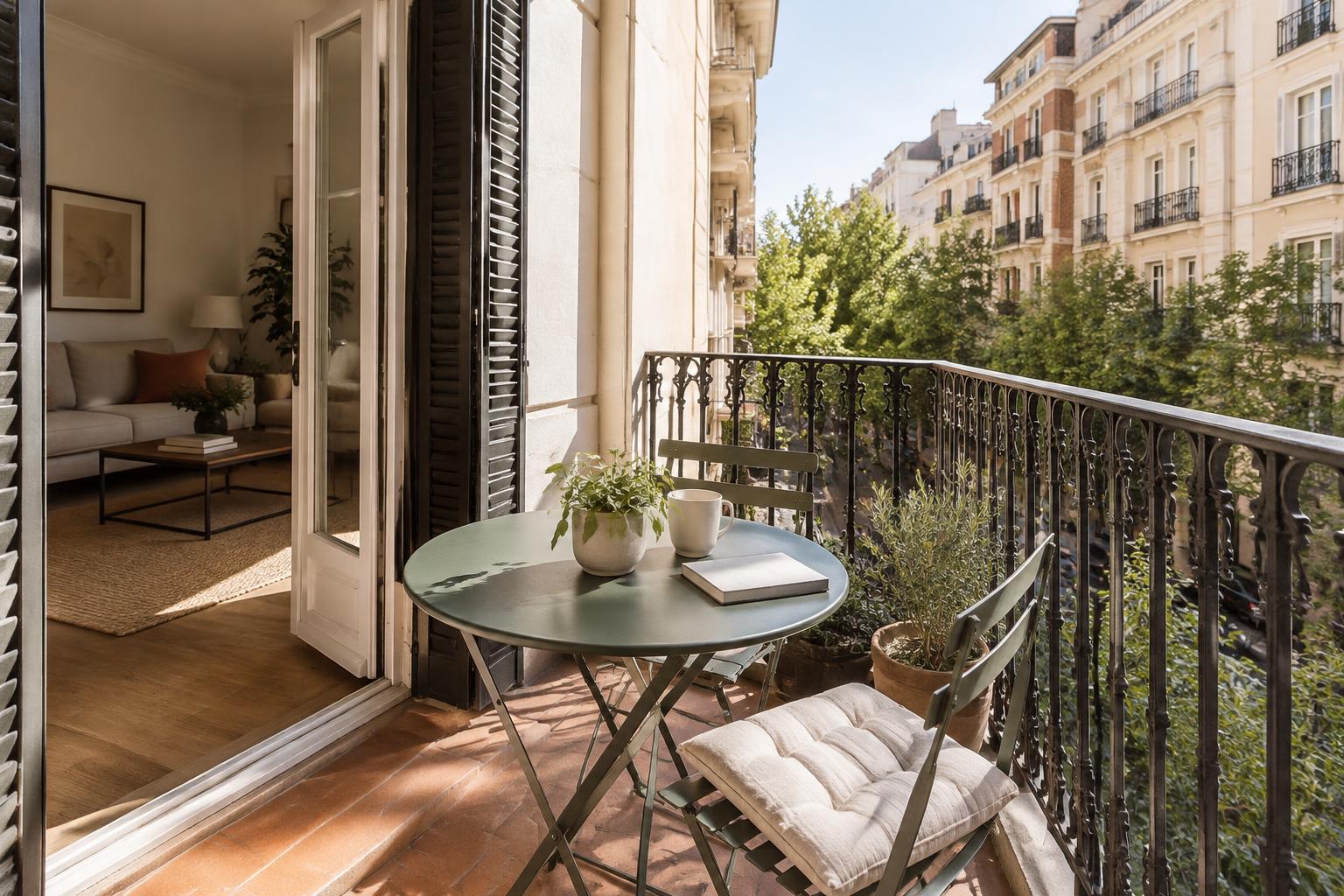
How to sell a flat in Almagro
Practical guide to selling a flat in Almagro with a milestone-based order: review, viewings and offers, using real local references and without invented haste.
Selling a flat in Almagro with an orderly process
Selling a flat in Almagro, in the district of Chamberí, should not be approached as a race against the clock or as an improvised decision. If you want a **property sale in Almagro** that is well resolved, it is advisable to work through specific milestones: review the property’s situation, prepare the viewing, open contacts, assess each enquiry and decide which offer is worth moving forward. That order helps you avoid common mistakes, especially when the transaction depends on several factors at the same time: the state of the building, documentation, price expectations and the interested parties’ real capacity.
The aim of this guide is to give you a practical roadmap for selling calmly, but without leaving the property “on hold” for too long. That means you should not focus only on publishing the advert and waiting. You should define what information is provided, when viewings are taken, what criteria are used to filter genuine interest and at what point a proposal stops being a simple conversation and becomes a serious offer.
If at any point you need an initial steer, you can request a **free valuation** at free valuation of your property or write via contact UBICASA. The service is handled from the real office at Montesa 29, in Madrid, Monday to Friday from 10:00-15:00 and 16:00-19:00.
First: check what is actually being sold and the state of the building
Before thinking about viewings, it is worth separating two aspects: the property and the building. If your flat has recent renovations, original features, exterior aspects, orientation or an especially usable layout, all of that matters; if not, that also matters, because it means the property has to be presented in a different way. In a **flat valuation in Almagro**, it is not enough to look at the interior: you need to review what the building contributes and what it detracts.
The basic legal and financial information must be clear before opening the door to buyers. The Community of Madrid states that, before the sale and purchase, it is important to check the legal situation through a land registry note, confirm that the property is up to date with IBI and community charges, and have the energy efficiency certificate available for the sale and purchase; it also distinguishes between deposits, private contracts and deeds, and notes that municipal capital gains tax and income tax may affect the sale Comunidad de Madrid. That general guidance does not replace individual advice, but it does set out the minimum you should review before promising timescales or accepting an offer.
Practical steps:
1. Ask for a review of the basic documentation.
2. Confirm whether there are any charges, issues or outstanding payments.
3. Prepare the energy certificate if it is not available.
4. Organise receipts and supporting documents that may be requested during the process.
5. Decide which points you want to explain from the outset and which only when there is genuine interest.
Common mistakes:
- Showing the property without having checked whether there is any relevant charge.
- Waiting until a buyer appears to look for documents.
- Assuming that the community charges or IBI “do not matter” until the end.
- Confusing an indicative estimate with an official valuation.
Local references to situate the building and choose comparables with judgement
When selling a **flat in Almagro Madrid**, the location must be treated precisely. It is not enough to say “it is in Almagro”: you need to know how the property is positioned in relation to recognisable local references and then choose comparables that truly make sense. The municipal map of the Almagro neighbourhood, in Chamberí, includes complete references such as **Calle de Zurbano**, **Calle de Miguel Ángel**, **General Martínez Campos** and **Paseo de la Castellana**; these references help situate the property or its surroundings, but they should not be used to assume automatically that any particular dwelling is next to them.
From there, the useful check is not about “sounding good”, but about comparing exact location and the building’s context:
1. Check which real part of the neighbourhood your building is in.
2. See whether the nearest reference is a main road, an inner street or an intermediate position.
3. Do not assume the building shares the same exposure, noise or accessibility as a nearby property.
4. Select comparables with characteristics that can genuinely be matched: floor, condition, lift, light, facade, renovation and layout.
5. Exclude from the analysis properties whose connection to the area is only apparent.
Practical tip: if two flats are “in Almagro” but one is better placed in relation to the surroundings and the other has a less attractive configuration, they should not be compared as if they were equivalent. The location relevant to the sale is not just the address; it is the set of micro-factors the buyer perceives when visiting.
How to organise enquiries, viewings and offers by concrete milestones
The distinctive approach to selling in an orderly way is to turn each stage into a filter. Not every enquiry is worth the same, not every viewing progresses, and not every offer deserves to enter negotiation. You gain control if you define in advance what must happen to move from one stage to the next.
### Milestone 1: initial enquiry
The first conversation is there to detect genuine interest. At this stage, it is worth responding only with the essentials: floor area, general condition, whether there has been a renovation, the building’s situation and, where appropriate, availability of basic documentation. Do not yet hand over all sensitive information if the person has not shown serious intent.
### Milestone 2: viewing
The viewing should prepare the next decision, not just show the home. Before opening the door, make it clear what the interested party can see and what needs to be confirmed afterwards. If your property has a strong point — for example, light, a recent renovation or an easily usable layout — show it in an orderly way. If it has a weakness — noise, a need for updating or outstanding issues — explain how it affects the whole without exaggeration or downplaying it.
### Milestone 3: offer
An offer is not judged only by the amount or how quickly it arrives. You also need to consider the buyer’s solidity, the conditions they propose and whether the timing fits realistically. The information from the Community of Madrid distinguishes between deposits, private contracts and deeds; therefore, you should not treat a reservation of interest as if it were already a completed sale and purchase Comunidad de Madrid. That difference is important in order not to rush.
Steps for deciding:
1. Note which documentation has already been shared.
2. Record what questions arise during viewings.
3. Separate offers with reasonable conditions from those that are only trying to buy time.
4. Compare each proposal with the actual state of the flat, not with generic expectations.
5. Reserve negotiation for offers that show continuity.
Mistakes to avoid:
- Accepting viewings without a minimum filter.
- Responding to every enquiry as if it were already a decided buyer.
- Confusing speed with seriousness.
- Negotiating before the property information is properly organised.
Hypothetical example of an orderly sale without invented haste
Imagine that you want to sell a flat in Almagro and receive several enquiries within a few days. One person asks general questions; another wants to know whether the building has a lift and when they could view; a third asks for more information but does not specify a time. Instead of answering everything at the same level, you organise them:
- To the general enquiry, you reply with a brief description and a viewing availability range.
- To the person asking for specific details, you provide the information needed to decide whether it is worth travelling.
- To the person who does not specify, you ask for a clear confirmation before setting aside time.
After the viewings, only one proposal moves forward. That offer is reviewed together with the documentation and the actual fit of the flat: whether the property needs some aspect brought up to date, whether the building has particular features or whether the buyer proposes conditions that lengthen the process. In this way, you do not sell on impulse; you sell by milestones. That method is especially useful when you are looking for a **property sale in Almagro** without manufactured urgency and with judgement.
What to check before accepting a proposal
Before moving ahead, use this checklist:
- Registry situation and relevant charges.
- IBI and community charges, where applicable.
- Energy certificate available.
- Type of contract intended to be signed.
- Realistic timescale from offer to signing.
- Consistency between the proposal and the property’s condition.
- Documentation needed so the process does not stall afterwards.
If any of this is unclear, it does not mean the sale stops, but it does mean it should be handled more carefully. In neighbourhood transactions, the costliest mistake is usually not asking too much, but accepting a proposal without checking its real fit.
How to rely on UBICASA without losing control of the sale
If you want a **estate agency in Chamberí** that works the neighbourhood with a real office and a clear process, you can use the free indicative estimate at free valuation of your property. That estimate is not an official valuation, but it does give you a range and a PDF report; in addition, if the case requires it, an optional visit may be considered. For specific questions or to activate the process, you can go to contact UBICASA or check the district page at Inmobiliaria chamberi.
You can also complement this guide with practical content on negotiation and documentation: Como vender piso madrid rapido, Negociar precio compra vivienda and Quien paga derramas vender piso antes arras. If your case involves inherited property or a building without a lift, you may find Vender piso heredado madrid and Vender piso sin ascensor transparencia useful.
In short, the best way to sell a flat in Almagro is not to improvise a quick exit, but to organise the sale by milestones: review, enquiries, viewings and offers. If you control that order, you reduce mistakes and reach the signing with greater confidence.