
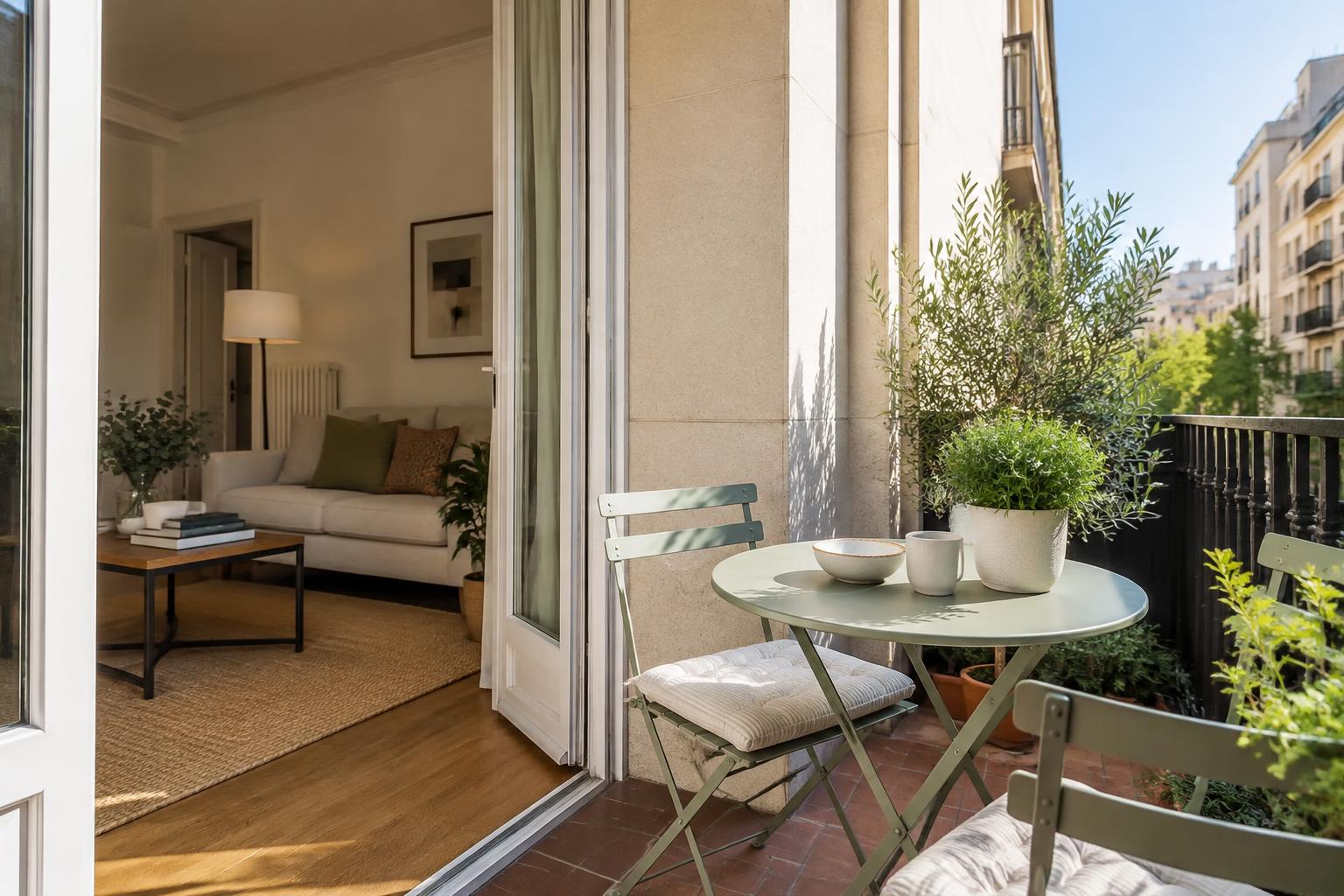
How to sell a flat in Argüelles
Practical guide to selling a flat in Argüelles in an orderly way: document review, viewings, offers and local comparables without rushing the decision.
Selling a flat in Argüelles with an orderly process
Selling a flat in Argüelles, within the Moncloa - Aravaca district, should not depend on urgency or improvisation. If you want to carry out a **property sale in Argüelles** with control, the starting point is not to publish the advert and wait, but to organise a clear sequence: review the property’s situation, prepare the presentation, define how enquiries will be handled, arrange the viewings and assess the offers against specific milestones.
That way of working helps avoid two common mistakes: accepting the first proposal without comparing it with the rest of real demand, or rejecting opportunities for lack of documentary criteria. In a **estate agency in Moncloa - Aravaca**, the value of the process lies in separating what can be verified from what only seems favourable at first glance.
If you would like an initial indicative reference for your case, you can request it in free property valuation. The online estimate is free, indicative, is not an official valuation and may include a range and PDF report, with an optional visit if a more precise analysis is needed.
What to review before publishing: the flat must be ready to answer questions
Before showing the property, it is advisable to gather and review the information that any serious buyer will ask for. The Community of Madrid’s guidance on buying and selling reminds us that it is important to check the legal status through a **land registry report**, verify the state of payment of IBI and community fees, and have the energy performance certificate where applicable. The same source also explains that in the earnest money agreement and the private contract, the property details, charges, price, method of payment and handover of keys must be made clear:
Useful steps before going to market:
1. Request the land registry report and confirm who is listed as owner and whether there are any charges or restrictions.
2. Check whether your building has any outstanding expenses with the community or for IBI.
3. Locate the energy performance certificate or arrange to obtain it if it is missing.
4. Gather deeds, receipts and any document that makes it easier to answer questions without doubt.
5. If the flat has distinctive features, prepare a clear and verifiable explanation: orientation, condition, renovations, attachments or issues, always without promising benefits you cannot prove.
Common mistakes at this stage:
- Publishing without having checked the registry status.
- Hiding charges or expenses to “buy time”.
- Confusing an indicative estimate with a fixed valuation.
- Assuming the buyer will not ask for documentation until the end.
How to use local references without inventing comparables
The local aspect matters, but it must be handled rigorously. The municipal map of the Argüelles neighbourhood, Moncloa-Aravaca district, identifies complete references that help to place the property or its surroundings, although they do not allow us to assume that all streets or facilities belong entirely to the neighbourhood. These references include **Plaza de España**, **Calle de Marqués de Urquijo**, **Calle de Alberto Aguilera** and **Calle de Princesa**. The map also reminds us that labels may include boundary or surrounding streets, so the exact location must be checked before selecting comparables:
How to turn those references into real actions:
1. Check the exact position of your property in relation to the map, without assuming that a nearby street belongs wholly to the neighbourhood.
2. Select comparables with reasonable matches in location, condition, size and floor, not just in neighbourhood.
3. If your property is near a neighbourhood boundary, also compare it with nearby properties that share the real market, not just the administrative label.
4. Note which features of the flat are truly comparable and which are not: lift, condition, exterior/interior, attachments or need for renovation, always according to what can actually be documented.
Practical tip: a good valuation of a flat in Argüelles is not based solely on the name of the neighbourhood. It is based on the exact position of the building, a careful reading of the map and a prudent comparison of equivalent properties.
Work order for enquiries, viewings and offers by milestones
If your aim is to **sell a flat in Argüelles** without rushing the negotiation, it is worth defining a milestone-based process. The point is not to delay decisions, but to avoid an informal enquiry turning into a poorly judged offer.
A reasonable sequence would be this:
1. **Milestone 1: initial enquiry.** Respond only with the essentials: general condition, documentation available, property status and basic viewing conditions.
2. **Milestone 2: filtering.** Before showing the flat, check whether the interested party fits the type of transaction you want to handle.
3. **Milestone 3: viewing.** Show the property clearly, without unnecessary embellishment and without hiding defects that will later be discovered.
4. **Milestone 4: second review.** If there is interest, ask for a written proposal or a clear confirmation before entering into negotiation.
5. **Milestone 5: offer.** Assess the offer alongside the documentation, deadlines, conditions and the level of security of the transaction.
6. **Milestone 6: earnest money or contract.** Only when everything has been reviewed should you formalise the next step with well-understood clauses.
This approach is useful because each milestone reduces uncertainty. For example, a phone call may seem very solid, but if there is no real capacity to complete the transaction afterwards, you will have wasted time. Conversely, a less spectacular proposal may be better if it brings fewer conditions, more organised documentation and a clearer negotiation.
Hypothetical example: same property, different decisions depending on the information
Imagine a flat in Argüelles whose building appears in the surroundings of one of the municipal map references, but you have not yet checked whether the property faces a main road, an inner courtyard or a secondary street. A buyer asks about renovations, expenses and registry status.
In a disorganised approach, you would answer from memory and accept a quick viewing so as not to “miss the opportunity”. In an orderly approach, you would do this:
1. Review the land registry report and confirm ownership.
2. Check whether there are any outstanding bills or any relevant community issue.
3. Prepare a brief explanation of the state of the property and what can be substantiated.
4. Check whether the map reference really helps to place the property or whether the exact surroundings need to be clarified.
5. Decide whether the viewing should take place before or after receiving an initial proposal.
The result does not depend on selling faster, but on selling with better information. That is the difference between a simple viewing and a sale managed by milestones.
Local checklist for Argüelles: checks before opening viewings
Use this list as a pre-check if you are going to market a flat in Argüelles:
- You have reviewed the land registry report and understand the essential information.
- You know whether the property has charges or issues recorded against it.
- You can prove the state of payment of IBI and community fees.
- You have the energy performance certificate available or planned.
- You have checked the exact location of the property against the neighbourhood map.
- You have decided which local references are useful for guiding the comparison and which are not.
- You have prepared brief answers to repeated questions about condition, attachments and documentation.
- You have defined when you will accept viewings, when you will ask for a proposal and when you will negotiate.
If your home has a particular feature — for example, if your property has a complex horizontal division, delicate common elements or an unusual documentary situation — it is advisable to treat it as an exception rather than a standard case for the neighbourhood.
When to ask for professional help and how to fit it into your plan
You can manage the first part yourself, but there are cases in which specialist support is advisable: if you are unsure about the documentation, if the property has charges, if the community has a pending matter or if you want to organise enquiries and offers more effectively without improvising.
From UBICASA’s real office at **Montesa 29, Madrid**, Monday to Friday from 10:00 to 15:00 and from 16:00 to 19:00, it is possible to coordinate the sale for Argüelles and for the rest of the neighbourhoods from a single working base. If you want to move forward, you can use contact UBICASA or visit the district page /inmobiliaria-moncloa-aravaca.
You can also complement this guide with related content that helps at specific stages of the process: /blog/como-vender-piso-madrid-rapido, /blog/negociar-precio-compra-vivienda and /blog/quien-paga-derramas-vender-piso-antes-arras.
Closing: sell methodically, not in haste
The best way to sell a home in this neighbourhood is not to promise results or assume that every property behaves the same. It is to organise the process: review, compare, filter, show, negotiate and formalise. If you apply those milestones and use local references prudently, you will have more control over the transaction and less room for avoidable mistakes.
And if you need an initial steer, you can request an estimate in free property valuation: it is a useful starting point, indicative and without obligation for an official valuation.