
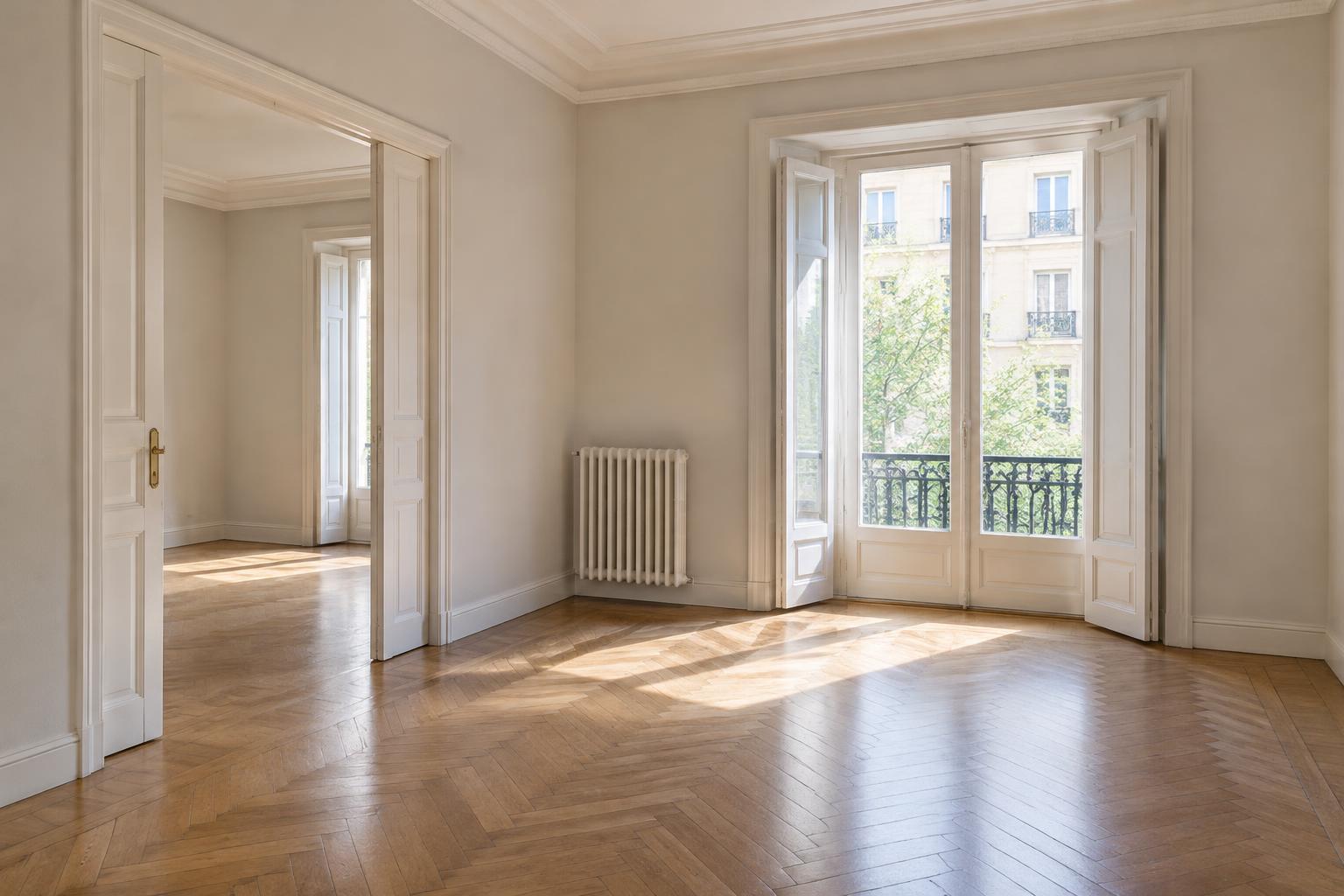
How to sell a flat in Lista
A practical guide to selling a flat in Lista, Salamanca district, taking into account accessibility, building services and comparables without assuming uniform characteristics.
What to check before selling a flat in Lista
Selling a flat in Lista involves more than preparing photos and publishing the listing. In a neighbourhood like this, where the area reference may be useful but not sufficient, the sale rests on three ideas: properly checking the specific building, placing its immediate surroundings with verifiable references and choosing comparables that really resemble your property.
The key is not to assume that all the buildings in the area have the same characteristics. If your building has a lift, concierge, courtyard, storage room, garage, resolved accessibility or some community service, that can greatly affect the buyer's perception. If it does not, that should also be explained transparently from the outset. The right presentation avoids unhelpful viewings and helps support the sale of a property in Lista with real arguments.
To start in an orderly way, you can use a free indicative valuation at free valuation of your property. It is not an official valuation, but it does serve as a starting point for deciding strategy, asking price range and commercial interest, with a PDF report and an optional visit if you need it.
How to place the building without assuming the neighbourhood is homogeneous
Before setting a price or writing the listing, it is worth locating your flat in relation to complete references in the surrounding area. On the municipal map of Lista appear, among others, these complete references that help place the building or its surroundings: **Hospital Universitario de la Princesa**, **Parroquia Nuestra Señora del Pilar**, **Colegio Concepcionistas** and **Instituto Nacional**. These are useful as spatial guidance, but they should not be used to conclude that a property is necessarily next door, nor to infer property types or demand profiles.
From those references, the practical work consists of this:
1. Confirm the exact location of the building in the property's internal documentation and in its full address.
2. Check which reference in the surroundings is genuinely nearby and which only serves as general guidance for the neighbourhood.
3. Avoid ambiguous phrases such as “next to” if you cannot support them with certainty.
4. Use that precise location to select comparables as similar as possible in condition, floor, lift, orientation and communal elements.
5. If your building is on a street with different commercial behaviour by section, separate comparables by micro-area rather than by neighbourhood label.
This step is especially important when you sell a flat in Lista because the perception of accessibility and building services may be more decisive than the mere name of the neighbourhood. One buyer may value a well-maintained building highly, while another prioritises a lift, concierge service or easy access. That is why the description should talk about the specific building, not the neighbourhood in the abstract.
How to assess accessibility and building services
In an estate agency in Salamanca, one of the first tasks is to translate the building's characteristics into clear selling points. There is no need to exaggerate; there is a need to be precise.
Use this practical check:
1. **Accessibility of access**: if your building has step-free entry, a ramp or equivalent solutions, describe it accurately. If they do not exist, it is better to flag this in advance and not hide it.
2. **Lift**: if there is one, check its condition, whether it serves all floors and whether the cabin gives a well-kept impression.
3. **Entrances and communal areas**: if the entrance hall has been refurbished, if the staircase is well preserved or if there is a need for updating, that should be reflected in the sales strategy.
4. **Community services**: if your building has a concierge, central heating, waste collection, storage room or garage, each element should be checked and documented precisely.
5. **Noise and building use**: if there are commercial premises, offices or mixed use that affects the property, this should be taken into account when assessing comparables and the sales narrative.
It is worth remembering a simple idea: not all flats in Lista or in the Salamanca district sell in the same way, even if they are only a short distance apart. The sale of a property in Lista improves when the listing and the viewings are prepared for the exact type of building, not for a generic image of the area.
### Common mistakes when valuing the building
- Assuming that because it is in the neighbourhood it will automatically have homogeneous demand.
- Presenting as an advantage a service that does not actually exist or is not operational.
- Mixing building features with district attributes.
- Comparing your property with flats on another floor, in another condition or with a different level of accessibility without justifying it.
- Hiding defects in the property and trusting that the buyer will not notice them.
How to choose real comparables to sell with criteria
The valuation of a flat in Lista should not be based on just any flats in the same area. The sensible approach is to look for comparables that resemble each other in what really changes the buyer's decision.
Take these selection criteria into account:
1. Size, layout and number of rooms.
2. Floor and the presence or absence of a lift.
3. Condition of the property and the building.
4. Quality of natural light, orientation and ventilation, if you can prove it.
5. Accessibility of the entrance and community services.
6. Exact location in relation to the surrounding references, without assuming distances that have not been verified.
If your flat has been recently renovated but the building has limitations, it is not advisable to mix both factors as though they carried equal weight. Conversely, if the building offers good access and services and the property needs updating, the strategy should reflect that without overpromising.
A hypothetical example: imagine an owner who wants to sell an internal flat, well maintained, in a building with easy access and a lift, but with fairly basic communal areas. In that case, the sales pitch should not focus on an abstract idea of “premium location”, but on the concrete combination of a functional building, a well-kept flat and a well-situated area. That way of presenting the property helps attract more appropriate viewings and reduces the sense of mismatch during negotiations.
Documentation and checks before showing the property
To prepare for going to market, it is not enough to tidy up the property. It is also worth reviewing the paperwork and the charges on the transaction. In the sale and purchase of properties, the Community of Madrid Administration recalls the importance of checking the legal status of the property through the land registry extract, verifying the payment status of IBI and community charges, and taking into account the energy performance certificate, among other matters. It also points out that a sale and purchase may involve deposits, a private contract and the deed, and that the property may carry charges with consequences for the buyer if they are not properly checked [[Compraventa de viviendas]]().
Useful steps for you:
1. Request or review the basic registry information to know who is selling and what charges exist.
2. Prepare community and IBI receipts and details, because the buyer usually asks for order and clarity.
3. Check whether you have a valid energy certificate to show the property normally.
4. If there are special assessments, issues or extraordinary expenses, organise them before starting negotiations.
5. Do not promise a quick completion if essential checks are still outstanding.
A complementary article on who pays special assessments when selling a flat fits well here, as does one on how to sell an inherited flat in Madrid if your case involves several owners or a previous transfer. And if you need to coordinate meter readings or handover of keys, you can rely on how to document meter readings when handing over a home.
How to prepare the listing, viewings and negotiation
Once you are clear about the building and the paperwork, the next phase is commercial. Here it helps to be specific and avoid overly broad messages.
Do this:
1. Write a listing that distinguishes between the property, the building and the surroundings.
2. Highlight only the building services you can prove.
3. Prepare brief answers to questions about accessibility, community and general condition.
4. Tidy the property so that the viewing is not distracted from its strong points.
5. Decide in advance which concessions you are prepared to consider and which you are not.
If you sell a flat in Lista, negotiation improves when the buyer perceives consistency between what was advertised and what they see. Trust is especially important in properties where the building weighs heavily in the decision. If your building has good access conditions and services, that can be a real asset; if not, honesty avoids losing credibility.
When to ask for professional help and how to use it well
Not every sale requires the same level of support, but it is sensible to rely on an estate agency in Salamanca when the building has nuances that need to be explained well or when the property needs a more refined comparable strategy. UBICASA's actual office at Montesa 29 works for all neighbourhoods, with opening hours Monday to Friday from 10:00-15:00 and 16:00-19:00.
If you want to move forward, you can contact UBICASA or request a free valuation. You can also get your bearings with the district page Inmobiliaria barrio salamanca and the general guide Como vender piso madrid rapido, always understanding that this Lista guide should help you ground the sale in your specific building.
Practical summary to avoid mistakes
Before publishing, check this list:
1. Are you clear about which specific building you are selling and what real services it offers?
2. Have you used surrounding references only as guidance, without assuming unverified proximity?
3. Have you chosen comparables similar in floor, condition, lift and accessibility?
4. Have you prepared basic documentation, charges and receipts?
5. Have you adapted the message to the real buyer of your property, not to a generic idea of the neighbourhood?
Selling a property in Lista works better when you combine precision, transparency and the correct selection of comparables. It is not about selling “the neighbourhood”, but a specific building with specific conditions. That difference, well explained, shapes the quality of the whole process.