
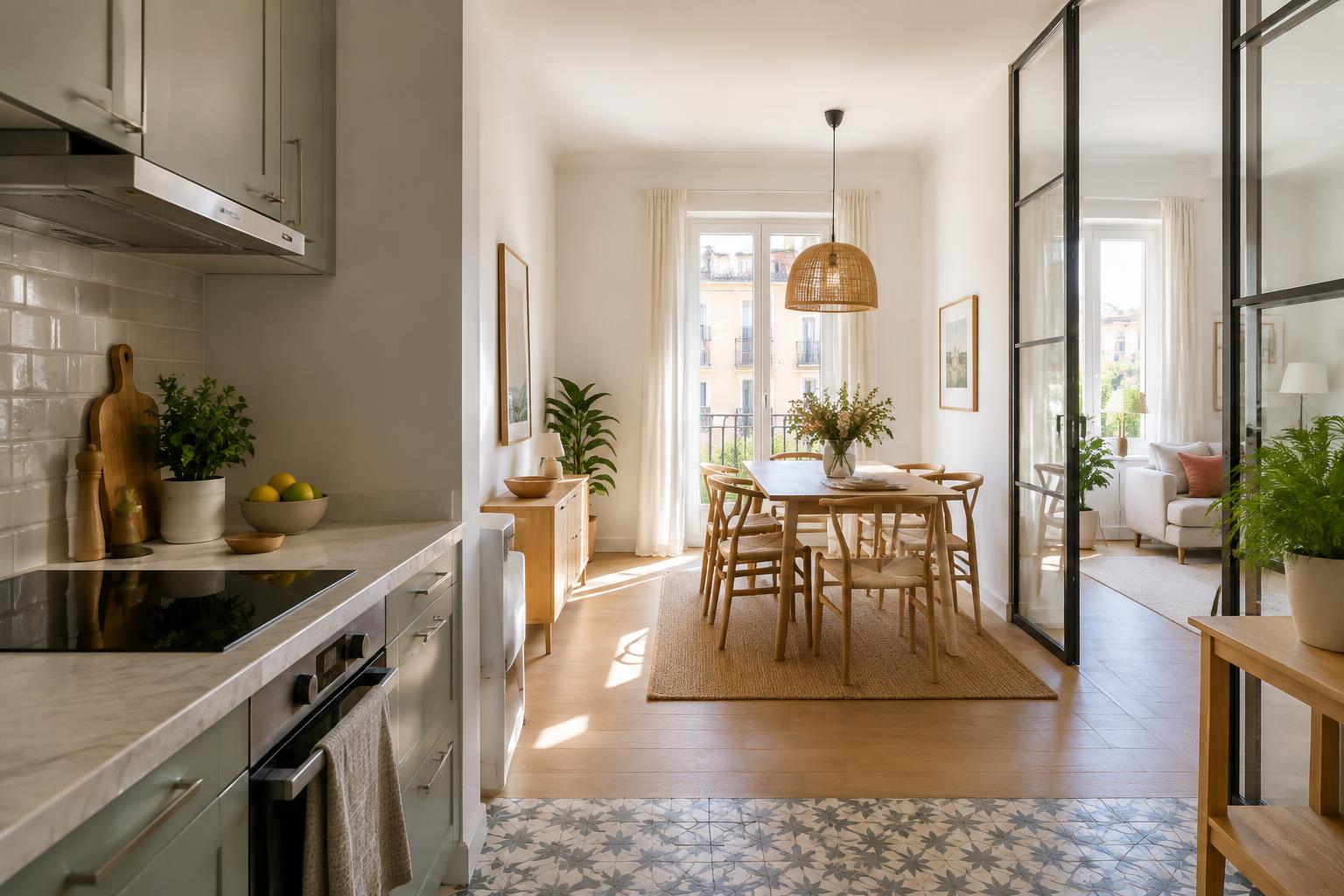
How to sell a flat in San Diego
A practical guide to selling a flat in San Diego, Puente de Vallecas, with a defensible valuation, well-chosen comparables and a clear dossier for buyers.
Selling a flat in San Diego with a valuation that can be defended
Selling a flat in San Diego is not just a matter of posting an advert and waiting for calls. If you want to complete a sale with less friction, the starting point is a defensible valuation and a clear narrative about why your property is worth what it is compared with others nearby. That is especially important in a neighbourhood where buildings with different characteristics may coexist: maintenance, layout, orientation, floor level, lift, residents’ association condition or internal renovation.
The key is not to “set a high price and see what happens”, but to prepare a technical and understandable explanation for the buyer. In practice, that means gathering evidence, organising the paperwork and building a sales dossier that makes the comparison with other homes justifiable. If your property has real advantages, it is worth documenting them; if it has weak points, it is also better to acknowledge and explain them honestly.
As a commercial guide, you can start with a **free valuation** for guidance. Remember that this is not an official appraisal; it serves to place the property within the market range and decide whether a later visit is worthwhile to refine the assessment.
What you should prepare before showing the property
Before showing the flat, do a practical review of everything a buyer will ask about at the first viewing or during negotiations. Do not wait until there is an offer to get the file in order. In a property sale in San Diego, response speed often influences as much as the asking price.
1. Gather the title deed extract, the cadastral reference, the latest residents’ association documentation and the receipts proving you are up to date with payments.
2. Prepare an accurate description of the property: usable and built area if known, layout, floor, height, orientation if verified, condition and any renovations carried out.
3. Identify which elements belong to the property itself and which relate to the building environment.
4. Check whether there are discrepancies between what appears in the deeds, cadastre, land registry and the physical reality.
5. Organise clean, up-to-date photographs, without forcing perspectives that later create mistrust.
If you want a general overview of the selling process in the capital, you can link internally to the guide **Como vender piso madrid rapido**. For the documentation side, this other guide complements the preparation work: **Documentos vender piso madrid**.
How to prepare a defensible valuation for nearby properties
This is the most useful point if you want to sell a flat in San Diego without relying only on instinct. A defensible valuation is not based on “what people are asking on the portal”, but on how genuinely useful comparables behave. And for that you need to distinguish between homes similar in floor, condition and building, and homes that only share the neighbourhood in a broad sense.
To build that comparison, it is worth following this order:
1. Define your property precisely: building, floor, orientation, lift, courtyard, condition, noise, light and renovation.
2. Select comparables that are as homogeneous as possible in age, type and condition.
3. Adjust each relevant difference mentally: a refurbished flat does not compete in the same way as one awaiting updating, and a property without a lift is not explained in the same way as one with a lift.
4. Prepare a short note justifying why apparently nearby but poorly comparable homes have been ruled out.
In San Diego, it also helps a great deal to explain the differences between nearby properties. If the buyer is deciding between two flats in the area, your argument should not be “mine is better because it is”, but rather “my home has these verifiable characteristics and therefore this other one is the correct comparison”. That approach reduces arbitrary haggling and gives the negotiation more solidity.
**Hypothetical example:** imagine two flats in the same wider San Diego area. One has been refurbished and is in a building in better condition; the other has a less efficient layout and needs updating. Although both are in the same neighbourhood, it would not be advisable to treat them as equivalent. The right approach would be to explain to the buyer which elements of each justify a different range and, if appropriate, rule out the one that is not comparable by condition, floor or layout.
If you need a second opinion on the value or the commercial positioning, you can use the **free valuation** service. If you would rather speak to an adviser, contact is available via **contactar con UBICASA**.
Local references that help place the property or its surroundings
To orient the buyer, you can rely on complete and verifiable references in the area that appear within San Diego and its district. They are not there to imply automatic proximity to any home; they are there to place the context if your property is reasonably nearby or if you want to explain what sort of surroundings it has.
These references include **Parque de Amós Acero**, **Mercado del Puente de Vallecas**, **Cine París** and **Colegio Público San José de Calasanz**. They are useful landmarks so that the buyer understands the part of the area where the home is located, but you should not assume that any flat in the neighbourhood is next to them. The correct approach is to verify the exact location of your property and check what real relationship it has with each one before using them in the sales description.
How do you turn those references into something useful?
1. Check whether your building or block is in the immediate surroundings of any of them.
2. If there is no real proximity, do not use them as a neighbourhood argument.
3. If there is, limit yourself to describing the surroundings cautiously: accessibility, day-to-day life, use of the space and how the neighbourhood is read.
4. Avoid turning local references into promises about demand, price or buyer profile.
This criterion also helps you choose comparables. A seemingly similar flat may be in a different part of the neighbourhood and therefore not useful for setting the price. That is why the buyer should see that you are not mixing homes based on simple nominal affinity.
Sales dossier: what should be explained to the buyer
A good dossier does not need to be long, but it does need to be coherent. The buyer is not just looking for photos: they are looking for reasons to trust you. If you are selling a flat in San Diego, the dossier should answer three questions: what exactly the property is, why it has been valued that way, and what distinguishes this building from nearby ones.
Include, at a minimum:
- Clear identification of the property and the building.
- Summary of physical characteristics: floor, lift, condition, verified orientation where applicable, layout and renovations.
- Explanation of the comparables selected and those ruled out.
- Residents’ association status and any relevant incidents, if there are any.
- Short text about the surroundings, using only local references that genuinely help to place the property.
- Main commercial argument: what kind of buyer may value this home most and why.
The idea is not to impress, but to reduce uncertainty. If the buyer perceives that you have prepared the file in an orderly way, it will be easier to hold the price and move towards reservation or deposit with fewer back-and-forths.
Common mistakes when selling in San Diego
There are mistakes that weaken a sale significantly even when the flat is well presented. Avoiding them is almost as important as setting the right price.
- **Confusing neighbourhood with comparability.** The fact that two flats are in San Diego does not mean they are equivalent.
- **Using local references without checking their real relationship to the property.** That can create mistrust if the buyer later checks and finds they were not nearby.
- **Hiding relevant defects.** It is better to explain them and offset them with solid arguments than to wait for the buyer to discover them.
- **Not organising the paperwork before the viewing.** Improvisation usually lengthens negotiations.
- **Using poorly comparable listings as the main guide.** An advert is no substitute for a well-worked valuation.
If you are moving into the negotiation phase, it is also worth reviewing **Contrato arras vivienda que revisar** so that nothing is left unresolved in the reservation or deposit stage.
When to ask for professional help and how to use the UBICASA office
If you want to sell a home in San Diego with a solid strategy, it can be useful to work with an estate agency in Puente de Vallecas that knows how to structure the comparison and prepare the sales pitch. UBICASA’s real office at **Montesa 29, Salamanca** handles sales across all Madrid neighbourhoods, including San Diego and the whole of Puente de Vallecas.
The online estimate is indicative and free; it is not an official appraisal. You can request it at **free valuation** and, if you then wish to move forward, use **contactar con UBICASA** to arrange the next step. The office opening hours are Monday to Friday, from 10:00 to 15:00 and from 16:00 to 19:00.
As a working principle, the best professional help is the kind that brings order back: a reasoned valuation, an understandable dossier and a selection of comparables that the buyer can follow without seeing contradictions. That is what most strengthens the sale of a property in San Diego when you want to explain properly the difference between nearby buildings.
On contractual closing, the general rules on property sales remind us that the title deed extract states charges and ownership, and that the seller must be able to prove certain relevant points for the transaction; moreover, the Comunidad de Madrid summarises that in deposits or reservation agreements the consequences must be clearly set out and that, in sales, the energy efficiency certificate must be available to the prospective buyer and handed over to the final buyer where applicable. That general guidance is set out in the Comunidad de Madrid’s property sale information.