
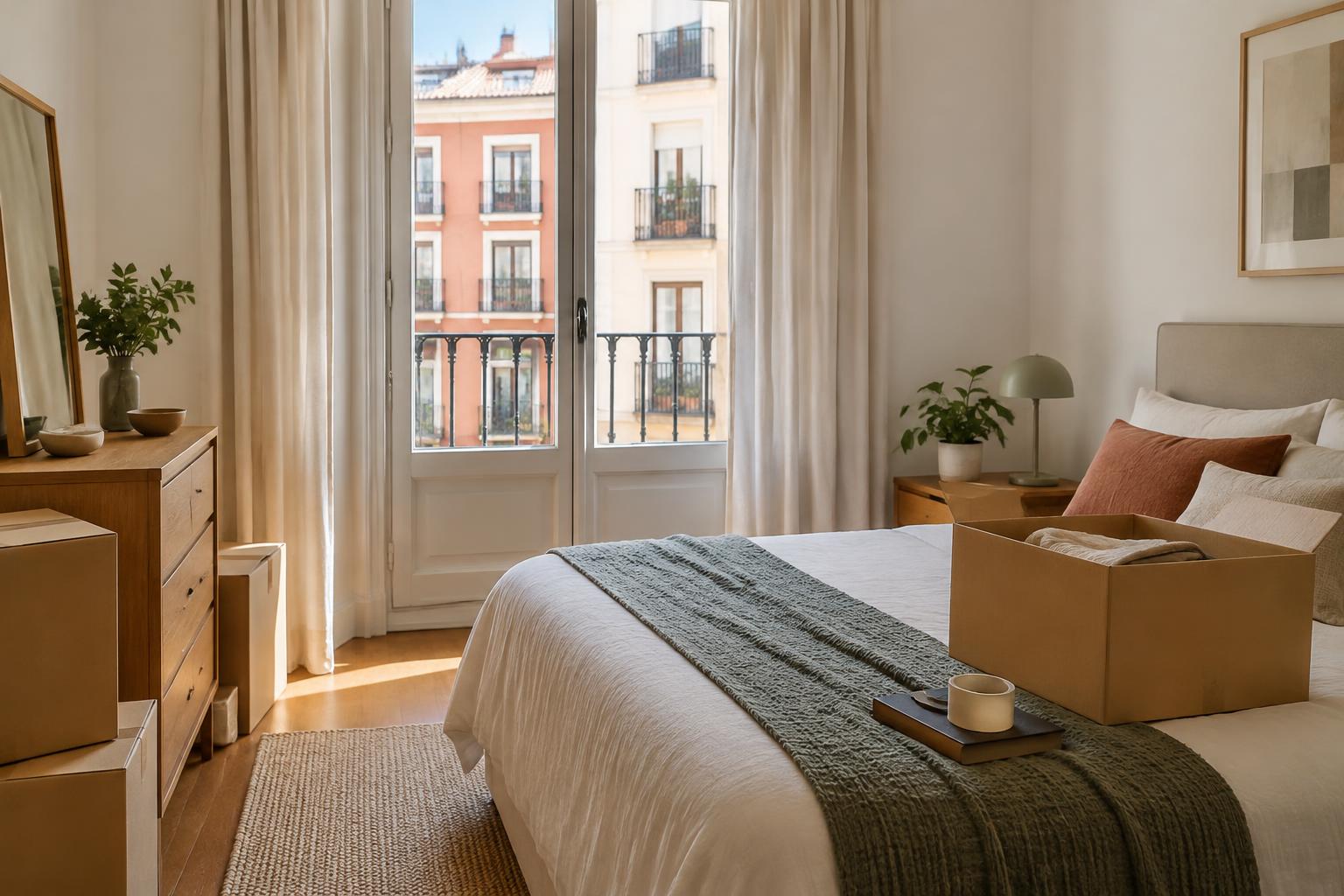
How to sell a flat in Universidad
Practical guide to selling a flat in Universidad, Centro district: how to defend the valuation, order comparables and prepare a clear dossier for buyers.
What you should prepare before showing the flat
Selling a flat in Universidad, within the Centro district, requires more than posting an advert and waiting for calls. If your aim is to close a sale with solid arguments, it is worth preparing a defensible valuation and a dossier that explains why your property should not be superficially compared with others nearby.
The key is to separate three layers: the legal and technical reality of the home, its exact position in the surrounding area and the way you present that information to the buyer. If the property has distinctive features — for example, if your flat overlooks an inner courtyard, if it is on a high floor, if it retains original features or if the residents’ association has carried out recent works — all of that should be documented precisely, because it can alter the way comparisons are made.
Before you begin, have these documents and details to hand:
1. Title deed or proof of ownership.
2. Cadastral reference.
3. IBI and residents’ association receipts, if you have them to hand.
4. Energy performance certificate.
5. Information on charges or land registry status, if you have already requested it.
6. Current photographs, without filters or misleading edits.
Also, remember that property sales in Spain require attention to matters such as the legal status of the home, verification of IBI and residents’ association payments, and handing over the energy certificate on sale. The Comunidad de Madrid summarises these practical points for property sales and also notes that the simple note provides information on ownership, charges and the description of the property, while the seller must have the energy performance certificate for sale transactions. Property sales
How to build a defensible valuation in Universidad
A defensible valuation is neither the highest nor the lowest: it is the one you can explain with data and reasonable comparables. In an area such as Universidad, where two nearby properties can differ greatly in layout, condition, orientation or residents’ association, the valuation must be based on careful comparisons.
It is advisable to follow this order:
1. Describe your home accurately: floor area, number of rooms, floor level, condition, lift, energy efficiency and distinctive features.
2. Separate what is verifiable from what is perception. For example, words like “bright” or “quiet” should be supported by orientation, floor level or the absence of noise in certain rooms.
3. Select comparables that share relevant characteristics, not just geographical proximity.
4. Mentally adjust for differences: if a comparable has recently been refurbished and yours has not, they are not equivalent even if they are close by.
5. Write a brief explanation for the buyer as to why those comparables are suitable and others are not.
The advantage of this approach is that it reduces discussions based on hunches. When you show an organised file, the buyer better understands why the asking price reflects the actual condition of the property rather than a generic reference for the area.
If you need an indicative estimate, you can request the free valuation from UBICASA at free valuation of your home. This estimate is indicative, not an official valuation, and can include a range and PDF report with an optional visit if the property needs to be reviewed in more detail.
Local references to place the property without forcing comparisons
The Universidad neighbourhood of the Centro district appears on the municipal map with references such as **Calle de San Bernardo**, **Calle del Barco**, **Plaza del Dos de Mayo** and **Calle de Fuencarral**. These references help situate the property or its surroundings, but you should not assume that a specific home is next to them or that they all share the same market reality.
Use those references as orientation points for a practical task: checking exactly where your building is and which comparables make sense. For example:
1. If your property is close to a main road, check whether noise, traffic or the frontage exposure affects demand.
2. If it is closer to a square or a side street, consider whether the sense of space or pedestrian flow changes the buyer’s perception.
3. If the building has different age, courtyard, lift or layout features from another flat in the area, do not treat them as equivalent.
4. If the buyer asks about “similar flats in the area”, show them which reference you used and why you accepted or ruled it out.
In practice, this means preparing a comparables sheet with an explanation for each one: what matches, what does not match and why it supports your valuation. This helps you avoid the common mistake of mixing “nearby” flats with truly comparable flats.
Buyer dossier: what it should include and how to explain it
A good dossier does not just sell better; it also reduces objections. Its purpose is for the buyer to understand the property, the building and the context without having to guess anything.
Include, at a minimum:
1. Brief description of the home and the building.
2. Clean and consistent photographs.
3. Energy certificate.
4. Simple note or land registry information, if you already have it prepared.
5. IBI and residents’ association receipts or status.
6. Explanation of why the chosen comparables are the most useful.
7. If appropriate, a note on renovations, maintenance or residents’ association agreements that affect the perception of the property.
In the sales explanation, do not promise what you cannot prove. For example, instead of saying “it is a very special home”, say what makes it different: floor level, layout, ventilation, light, condition, or whether it retains original features. If the property has a courtyard, a particular façade or a distinctive configuration, describe it objectively and with photographs.
Hypothetical example of sale preparation
Think of a hypothetical flat in Universidad that you want to sell. Do not start from the idea that all homes in the neighbourhood are similar; start from the opposite idea: that there are important differences between nearby properties.
Suppose your home has a practical layout, but retains older finishes. A nearby comparable may have been refurbished and another may be similar in condition, but with better light due to its height. A third may share the same age, although it has worse internal use of space.
The right decision would not be to choose the price of the prettiest one or the closest one, but to explain to the buyer:
1. What features your flat shares with each comparable.
2. What material difference exists in condition, floor level, light or layout.
3. Which property serves as the main reference and which only as support.
4. What argument justifies keeping your price without overinflating it.
That dossier is especially useful if the buyer comes with references from other parts of the Centro district or with poorly calibrated preconceptions. You are not arguing with opinions: you are responding with a structured comparison.
Common mistakes when selling a flat in Universidad
There are several pitfalls worth avoiding from the outset:
1. Setting the price before ordering comparables.
2. Presenting a refurbished home and one that has not been refurbished as if they were equivalent.
3. Hiding or downplaying charges, fees or residents’ association issues.
4. Failing to prepare a clear explanation of the property’s exact location.
5. Confusing an indicative estimate with an official valuation.
6. Using generic wording that could apply to any neighbourhood in Madrid.
It is also a mistake to think that the buyer only looks at the advert. In reality, many buyers compare the home with others within the same district, and in Universidad the differences between nearby properties can be decisive. That is why your best tool is not a sales phrase, but clear and coherent documentation.
How to move forward in an orderly way with UBICASA
If you want to sell with professional support, UBICASA manages sales from its real office at calle Montesa 29, in Madrid, for all neighbourhoods. You do not need a fictitious office in Universidad to handle the file well; you need a solid method, a reasoned valuation and an honest sales pitch.
You can start with three concrete actions:
1. Request a free indicative valuation at free valuation of your home.
2. Contact the team at contact UBICASA to review your case.
3. If you want district context, consult the page Inmobiliaria centro and then link it to the specific strategy for your property.
As a complement, you can read the general guide Como vender piso madrid rapido, as well as these two useful reads for deciding the home’s pre-sale condition and your negotiation approach:
- Is it worth refurbishing a flat before selling it?
- How do you negotiate the purchase price of a home?
Final checklist before going to market
Before publishing, review this final section:
1. Does the description distinguish facts from opinions?
2. Have the comparables been chosen for real similarity and not just proximity?
3. Is the property well placed with specific references to the surrounding area?
4. Does the dossier explain why your home is worth the price you are asking?
5. Do you have the basic documentation required for the sale ready?
6. Does the sales message avoid exaggeration and rely on verifiable data?
If you answer yes to everything, you will no longer be selling “just any flat” in Universidad, but a well-presented home, defended with criteria and easier for a serious buyer to understand.