
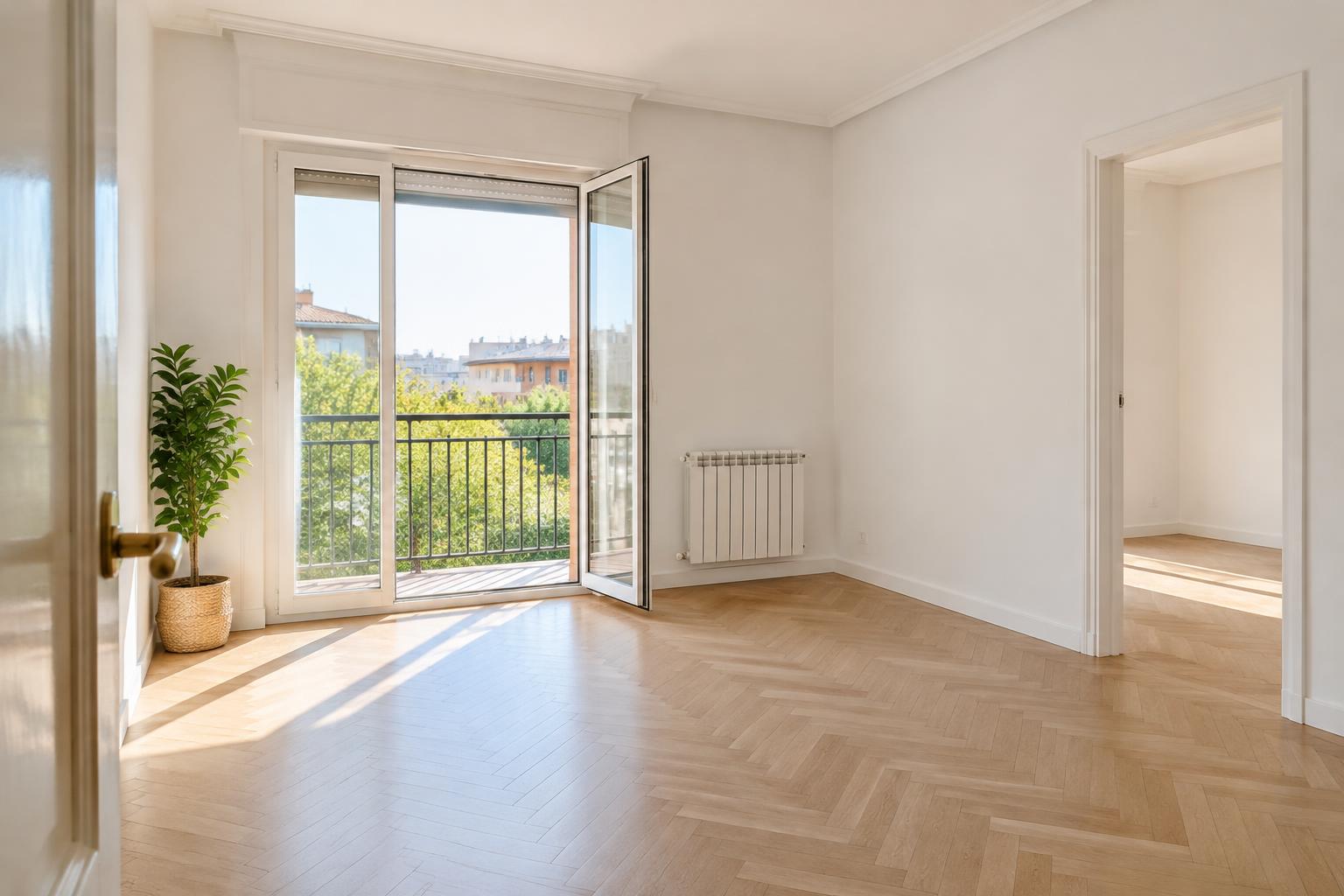
How to Sell a Flat in Ventas
A practical guide to selling in Ventas, Ciudad Lineal, focused on viewings, objections about noise, light and layout, with real checks and local references.
Before showing the flat: what to check in Ventas
Selling a flat in Ventas is not just a matter of posting photos and waiting for calls. If you want the viewing to move forward, it is worth preparing the home to answer the questions that most often hold back a decision: noise, light and layout. In an urban area, those objections are not resolved with opinions, but with visible, comparable and easy-to-show checks.
If the property is handled as a property sale in Ventas, the first step is to organise information about the building and the surrounding area without assuming anything. The municipal map of the Ventas neighbourhood, in the Ciudad Lineal district, helps to place the building or its surroundings, but it does not allow you to assume that every street belongs entirely to the neighbourhood or to infer prices, travel times, safety or resident profile. On that map, complete references appear such as Plaza de Bami, Parque del Pinar de La Elipa, Avenida de las Trece Rosas and Cementerio de Nuestra Señora de la Almudena, which can be used to orientate the property and select comparables more judiciously.
Initial steps:
1. Gather the simple note, IBI and community charges receipts, and check that the property is ready to be shown.
2. Do a light and noise walk-through at two times of day if possible.
3. Note which rooms receive genuine natural light and which depend on artificial lighting.
4. Observe whether the layout creates long corridors, dead corners or rooms that are difficult to furnish.
5. Prepare answers based on facts, not promises.
How to detect noise objections without assuming them
When a buyer visits a flat in Ventas Madrid, the noise objection may arise even before it is voiced. Your job is to identify it beforehand and respond with verifiable facts. Do not say “there’s no noise here” if you have not checked it. It is better to explain what you have reviewed and what the visitor can see.
If the building faces a main road, an inner courtyard or an open space, that affects the acoustic perception, but every home is different. That is why it is worth distinguishing between façade orientation, height, the condition of the windows and the actual use of the rooms. A flat with double glazing, for example, does not by itself eliminate noise, but it can help to reduce the sensation in certain rooms. If the main bedroom faces the courtyard and the living room faces the street, do not immediately claim that “it’s quiet”; show which room is more exposed and let the buyer check it for themselves.
Checklist for the viewing:
1. Close the windows and listen for several minutes before opening them.
2. Check whether traffic can be heard from the living room, bedrooms and kitchen separately.
3. Open and close the shutters to detect vibrations, rubbing or looseness.
4. Note the times when noise is most noticeable.
5. Explain any improvements already made, such as renewed joinery or sealing, only if they exist.
Common mistake: turning a suspicion into an argument. If you claim that “you can’t hear anything”, the buyer may lose confidence as soon as they detect even a slight transmission of sound. It is better to say: “I have checked the noise level at different times and this is the least exposed room”.
Natural light: how to show it and not promise it
Light is one of the factors that most influences the purchasing decision, but also one of the easiest to exaggerate. To sell a flat in Ventas with transparency, it is worth showing the real light that comes in, without over-editing it in the photos or relying only on the impression of a sunny day.
The useful check is not “there is lots of light”, but “what comes in, at what times and in which rooms”. If the kitchen has less light than the living room, or if a bedroom depends on a small window, the viewing should anticipate it. The advantage is not in hiding it, but in showing how the home works and what uses each room allows.
Practical actions:
1. Take photos at different times if you can.
2. Open curtains and blinds before the viewing to compare the real feeling.
3. Identify rooms with direct light and rooms with filtered light.
4. If there are courtyards, skylights or internal openings, show them without embellishment.
5. Avoid very powerful lamps during the day if they distort the perception.
If you use an estate agency in Ciudad Lineal to sell, ask for the images and text to describe the light in concrete terms: the orientation of the rooms, the type of opening and how the home behaves at different times. That gives more credibility than a generic phrase.
Layout: the point that changes the buyer’s perception the most
Layout is not corrected with opinions, but with a walkthrough. A flat can seem small or awkward if the flow between areas is poorly resolved, but it can also gain perceived value if you clearly explain how each space is used. Here the key is to show circulation, storage and the real possibilities for furniture.
Questions to ask yourself before the viewing:
1. Are there corridors that consume usable metres without adding any use?
2. Is the kitchen separate or conveniently connected to the rest of the home?
3. Do the bedrooms allow for a bed, wardrobe and enough circulation, without inventing measurements?
4. Is there a work or storage area that the buyer can easily imagine?
5. Does the floor plan force awkward crossings between day and night areas?
Hypothetical example: imagine a flat with the living room at the front, the kitchen at the back and two bedrooms in a line. Instead of saying it is “very well laid out”, it is better to show where people move through, where space is lost and what furniture fits without blocking doors. That account helps more than a generic description.
Common mistake: masking a layout problem with décor. If there is a difficult corner, the buyer will see it. It is better to leave it clear, mentally measure it with simple furniture and explain what it could be used for.
Local references to place the property and choose comparables
In the Ventas neighbourhood, the municipal map provides useful references for locating the property or its surroundings, but it should not be used to assume the exact proximity of other homes. This matters a great deal if you are preparing a flat valuation in Ventas: comparables must be selected by real location, condition and characteristics, not by intuition.
Complete references that may help you orient yourself:
- Plaza de Bami
- Parque del Pinar de La Elipa
- Avenida de las Trece Rosas
- Cementerio de Nuestra Señora de la Almudena
How to turn those references into action:
1. Use the map to locate the property accurately, not to infer its value.
2. Check whether the comparables you study are really in the same functional area.
3. If a reference property is more exposed to traffic, noise or lack of light, do not treat it as equivalent without justification.
4. Prioritise properties with similar layout, condition and height.
5. If in doubt, verify the exact location before taking it as a comparable.
How to organise viewings that inspire confidence
A well-prepared viewing sells more through clarity than through insistence. In a property sale in Ventas, the aim is not to convince the buyer through pressure, but to leave them few reasons to imagine problems you have not shown.
Recommended order:
1. Start at the entrance and explain the general circulation.
2. First show the room with the best light and the best sense of space.
3. Then show the bedrooms and any rooms with possible objections.
4. Answer each question with a concrete check.
5. Close the viewing with the documentation ready to continue if there is interest.
Useful tips:
- If there is a clear objection, address it before the buyer misinterprets it.
- Do not force positive comments about noise or light.
- Let the visitor see the property in real conditions, not just in “presentation” mode.
- If the building has features that may affect perception, explain how they are experienced day to day without exaggeration.
What to do after the viewing and how to rely on UBICASA
After each viewing, note which questions are repeated. If several people ask about noise, light or layout, that is probably where the focus of the strategy lies. This allows you to adjust the wording, the photos and the selection of comparables.
If you want to check the indicative price before putting the property on the market, you can request a free estimate in valoración gratuita de su vivienda. That estimate is indicative, not an official valuation, and includes a range and PDF report; if you wish, it can be completed with a visit. To resolve doubts or coordinate the sale from the real office at Montesa 29, you can use contactar con UBICASA. Support is provided from Salamanca for all neighbourhoods, including Ventas.
You can also broaden your approach with these complementary guides:
- /blog/como-vender-piso-madrid-rapido
- /blog/quien-paga-derramas-vender-piso-antes-arras
- /blog/como-documentar-lecturas-contadores-entregar-casa
And if you need a district overview, /inmobiliaria-ciudad-lineal is available. If your case requires reviewing documentation or specific conditions, general guidance does not replace individual advice.
Mistakes worth avoiding when selling in Ventas
1. Describing a flat as “quiet” without having checked it at different times.
2. Saying it has “lots of light” without having photographed and visited the property in real conditions.
3. Defending a complicated layout with adjectives alone.
4. Choosing comparables by neighbourhood intuition rather than exact location and real similarity.
5. Hiding objections instead of preparing for them with transparency.
If you sell a flat in Ventas with this approach, the conversation with the buyer changes: it moves from suspicion to verification. And that, in a viewing, is usually a much stronger advantage than any sales phrase.