
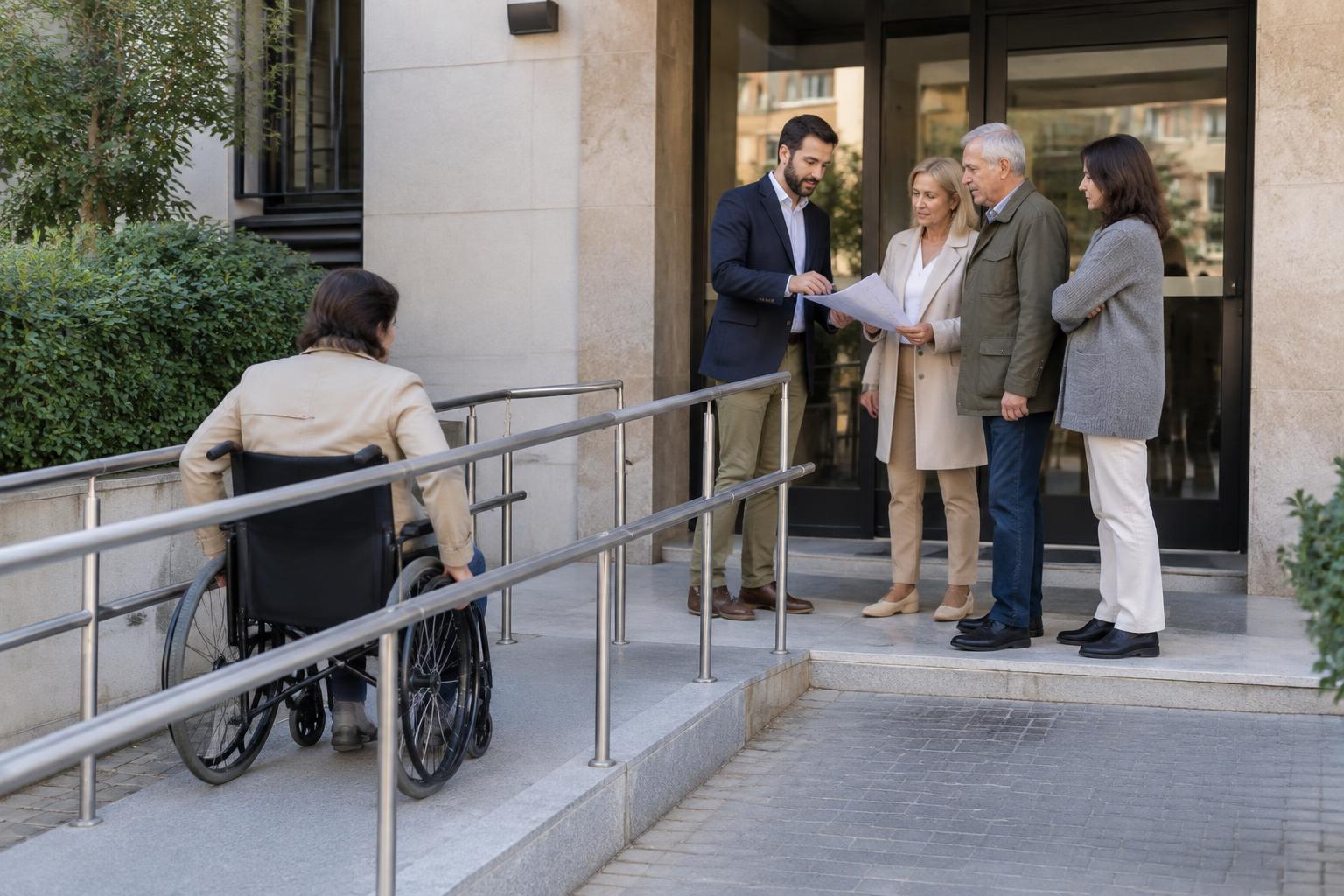
How accessibility works are approved in a homeowners’ association
Before pushing ahead with a ramp, a lift or any other accessibility measure, it is worth knowing what majority is required, how the costs are shared and what documentation should be set out in writing to avoid later challenges or disputes.
What you should check before bringing the proposal to the community
Accessibility works often raise questions because they are not all approved by the same majority and they do not all have the same financial treatment. If you are a property owner and want to promote this kind of measure, it is worth distinguishing between works that are mandatory, those that require a homeowners’ meeting resolution and those that depend on a reinforced majority. The legal basis is found in the Horizontal Property Act and, in particular, in articles 10 and 17 of the law, which regulate mandatory works, homeowners’ meeting resolutions and the way costs are to be shared. Under the current legal regime, works necessary to guarantee universal accessibility and reasonable adjustments may be mandatory in certain cases, and the community must act within the majority framework provided for in law Ley 49/1960, de Propiedad Horizontal.
Before calling a meeting, check the following:
1. What specific problem you want to solve: access to the entrance hall, steps, lift, concierge desk, accessible route, etc.
2. Whether the measure affects common parts, the title deed or the bylaws.
3. What part of the cost would be borne by the community and which, where applicable, by the applicants.
4. Whether there are grants or financing that should be taken into account when calculating the special levy.
5. Whether the proposal can be carried out without preventing another owner from using any part of the building.
Majorities and rules that usually apply
Not all accessibility works are voted on in the same way. The Horizontal Property Act distinguishes between several situations:
- Works necessary for proper maintenance and to comply with the duty of conservation may be mandatory.
- Measures to guarantee universal accessibility and reasonable adjustments may also fall within the scope of article 10.
- Where homeowners’ meeting resolutions are concerned for accessibility works, the law sets out specific majorities in article 17.
In practice, the key is not to confuse a voluntary improvement with a measure required by law. If you present a proposal as though it were a simple improvement when in reality it falls under mandatory works, it may end up being discussed under the wrong majority and lead to later challenges.
Recommended steps:
1. Set out in writing what work is proposed and why it is necessary.
2. If possible, request a technical report describing the scope of the work.
3. Obtain comparable quotes so that the meeting votes with sufficient information.
4. Include approval of the work, the method of financing and the payment schedule in the agenda.
5. State whether the work requires affecting common parts or altering the building.
How costs are shared and what limits should be kept under review
In homeowners’ associations, the sharing of costs does not depend solely on the resolution: the applicable legal rule also matters. Article 9 of the Horizontal Property Act provides that each owner must contribute, according to their share of participation or as otherwise specifically established, to the general expenses of the property. In addition, the Act itself states that the reserve fund must be used, among other things, for conservation, repair, refurbishment and accessibility works.
In accessibility matters, the law provides that, when valid resolutions are adopted for the carrying out of accessibility works, the community is liable for payment of the expenses. This means two points must be checked carefully:
- whether the cost must be shared according to the ownership share or the criterion laid down in the title deed or in a valid resolution;
- whether there is an annual limit on the amount passed on in some cases and how grants or financing operate.
Common mistakes:
- Approving the work first and leaving the cost sharing for later.
- Failing to distinguish between an extraordinary levy and an ordinary expense.
- Forgetting that resolutions must precisely state the work, the amount, the payment system and the effect on absent owners.
- Assuming that a dissenting neighbour is exempt without checking whether the law allows such exemption.
Documentation that should be kept on file
If the community approves accessibility works, it is advisable to keep a full record of the resolution. This helps if there are later questions about the special levy, the contracting or a possible challenge.
Keep at least:
1. The meeting notice and agenda.
2. The priced quotations.
3. The minutes recording the resolution adopted.
4. The technical or descriptive documentation for the work.
5. The breakdown of the special levy and the collection system.
6. The notifications sent to absent owners.
If the work is linked to a future change to the building or to an alteration of common parts, it is also advisable to review the horizontal division deed and the bylaws, as there may be specific provisions on use, cost allocation or restrictions on certain works.
When it is worth seeking professional help
There are cases where the issue cannot be resolved simply by reviewing the minutes. For example, if the community disputes whether the work is mandatory or voluntary, whether the resolution affects the title deed, whether the special levy is correct, or whether an owner wishes to challenge the resolution. It may also be useful when the community needs to assess the documentation for a property before selling it or when you want to know how a future work would be reflected in the marketing of the home.
If you would like property advice on how this type of resolution may affect the value, sale or marketing of your home in Madrid, you can request an indicative valuation at valoración online de vivienda en Madrid. The estimate is indicative, includes a range and a PDF report, and can be completed with an optional visit.
If you would rather explain your specific case, you can write to us via contact or visit us at our office at Calle Montesa 29, Madrid, Monday to Friday from 10:00 to 15:00 and from 16:00 to 19:00.
In short, the key is to separate three levels: what the law allows, what the meeting validly decides and what must be documented. If those three elements fit together, the community greatly reduces the risk of conflict.