
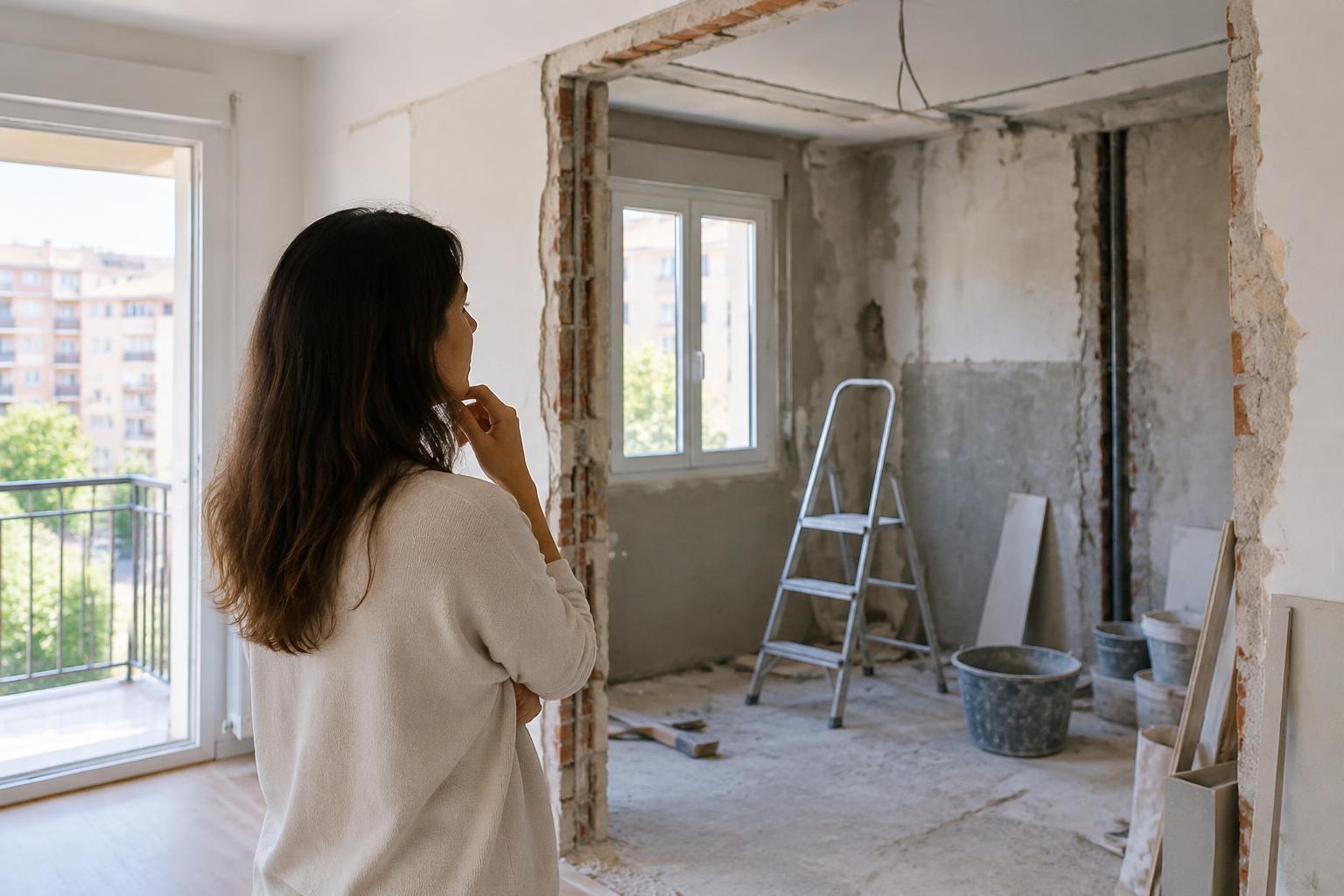
Unliveable dwelling during a tenancy: what to check if there are building works
If the works make the dwelling temporarily unliveable, it is worth checking whether we are dealing with a maintenance intervention, what evidence to gather, how to notify the landlord, and when the contract may be suspended or you may withdraw without general compensation, according to the LAU.
What to check first if there are works and the dwelling is no longer habitable
When works appear in a rented property, the important issue is not only who is carrying them out, but whether those works genuinely affect the normal use of the dwelling. That nuance changes the legal response considerably. Not all nuisance justifies the same reaction: a minor job in the building is not the same as work inside the flat that makes it impossible to live there normally.
The basic reference, for the purposes of a residential tenancy, is the Urban Leases Act. In particular, the contract and the factual situation must be read alongside the landlord’s duty to maintain the property and the regime for suspension or withdrawal when the dwelling becomes uninhabitable because of works. The LAU is the starting point and its agreements cannot, to the tenant’s detriment, disapply the mandatory rules of the housing title BOE-A-1994-26003.
Before assuming that you must leave or stop paying, it is worth checking three things:
1. Whether the works are maintenance, repair or improvement.
2. Whether the dwelling remains usable or, on the contrary, has lost its habitability.
3. Whether there is written communication from the landlord explaining the scope, duration and planned measures.
Difference between maintenance works and works that make the dwelling uninhabitable
The law distinguishes between the landlord’s duty to keep the dwelling in habitable condition and other works that may affect the property in different ways. In practice, this means looking at the real effect of the works, not just their name.
Maintenance works are usually those needed to keep the dwelling fit for the agreed use. If the landlord acts to repair damage, fix faults or comply with their maintenance duty, the tenant cannot normally treat the situation automatically as if the contract had ended.
However, if those works prevent you from living in the dwelling, whether because of noise, dust, interruption of utilities, inaccessible rooms or risk to health or safety, the picture changes. The key question is whether the dwelling is still habitable. If it is not, it should be checked whether suspension of the contract for the necessary period is appropriate, or even the tenant’s withdrawal, without any general compensation arising in the landlord’s favour simply for that fact alone.
It is worth not confusing “nuisance” with “uninhabitability”. A disruptive work may be debatable; work that makes reasonable use of the dwelling impossible has a different legal treatment.
What to do step by step if the works affect use of the dwelling
1. **Review the tenancy agreement.** Check whether there are clauses on works, access to the dwelling, notices, repairs and possible compensation arrangements. If any clause reduces the tenant’s rights in a way contrary to the LAU, it may not be valid in that respect.
2. **Document the condition of the dwelling.** Take dated photographs and videos, keep messages, work notices, estimates or building notices, and record which rooms cannot be used and why.
3. **Notify the landlord in writing of what is happening.** Explain clearly what works are taking place, since when, how they affect habitability and what solution you are requesting: rectification of the problem, temporary relocation, suspension of the contract or withdrawal, as appropriate.
4. **Distinguish between works by the landlord, the building management or third parties.** An internal repair ordered by the owner is not the same as communal works. The response may vary, but the decisive factor remains the impact on habitability.
5. **Do not leave the dwelling without leaving a record.** If you decide to move out, leave a clear documentary trail showing that you are doing so because of the uninhabitability caused by the works. This avoids later disputes about simple abandonment or ordinary withdrawal.
6. **Ask for written confirmation of any agreement.** If the parties agree a temporary move, a suspension, a reduction or a provisional handover of keys, this must be in writing to avoid disputes over rent, deposit or deadlines.
Suspension, withdrawal and the absence of general compensation
This is the core issue. When works make the dwelling uninhabitable, the LAU allows for the possibility of reviewing whether **suspension of the contract** is appropriate while the inability to use the property lasts, or the tenant’s **withdrawal** if maintaining the relationship is no longer reasonable. The practical idea is that the tenant should not be required to continue paying for a dwelling they cannot occupy normally.
In addition, in an ordinary withdrawal by the tenant the law already establishes that, when exercised in the legal terms, **it does not give rise to a right to compensation in favour of the landlord**. That general rule reinforces the idea that the tenant’s departure, when it is due to a cause covered by law or to a properly exercised withdrawal, should not automatically become an economic penalty for them.
For practical purposes, check whether any of these situations apply:
- the dwelling is partly or completely unusable;
- the works were not foreseeable to that extent when the contract was signed or renewed;
- the impact is not isolated but continuous;
- there is a real impossibility of living there normally.
By contrast, if the dwelling remains habitable and the works only cause temporary inconvenience, the answer may not be suspension or withdrawal, but rather negotiation about timings, access, hours or possible compensation if the parties wish to agree it.
Common mistakes to avoid
- **Leaving the dwelling without written notice.** Later on, it may be disputed whether there was a valid withdrawal or simple abandonment.
- **Stopping rent payments without analysing the case.** Non-payment without documentary support can create an additional dispute.
- **Confusing maintenance works with voluntary improvements.** The analysis changes depending on the purpose and impact of the works.
- **Accepting verbal agreements.** If there is a suspension or temporary move-out, always ask for a signed text or one exchanged by reliable means.
- **Thinking that every work allows you to terminate the contract.** Only the impact on habitability and the specific legal response justify that decision.
If you would like to review your specific case, you can request an initial consultation at /contacto or an indicative value estimate for your property at /valoracion-vivienda-madrid. The online valuation is indicative, provides a range and a PDF report, and can be completed with an optional visit.
What is worth confirming in writing
When there are works and the dwelling becomes unusual or uninhabitable, the best protection for both tenant and landlord is documentation. Before making a decision, set out in writing:
1. the date the works started;
2. the part of the dwelling affected;
3. the reason for the uninhabitability;
4. the proposed solution;
5. the expected end date, if there is one;
6. what happens to the rent, the deposit and the handover of keys.
If the dispute is not clarified by the initial communication, the prudent course is to seek an individual review of the contract and the evidence. General guidance helps to understand the legal framework, but each case depends on the type of works, the real extent of the impact and what has been agreed.
For in-person assistance, UBICASA is at Calle Montesa 29, Madrid, Monday to Friday from 10:00 to 15:00 and from 16:00 to 19:00.