
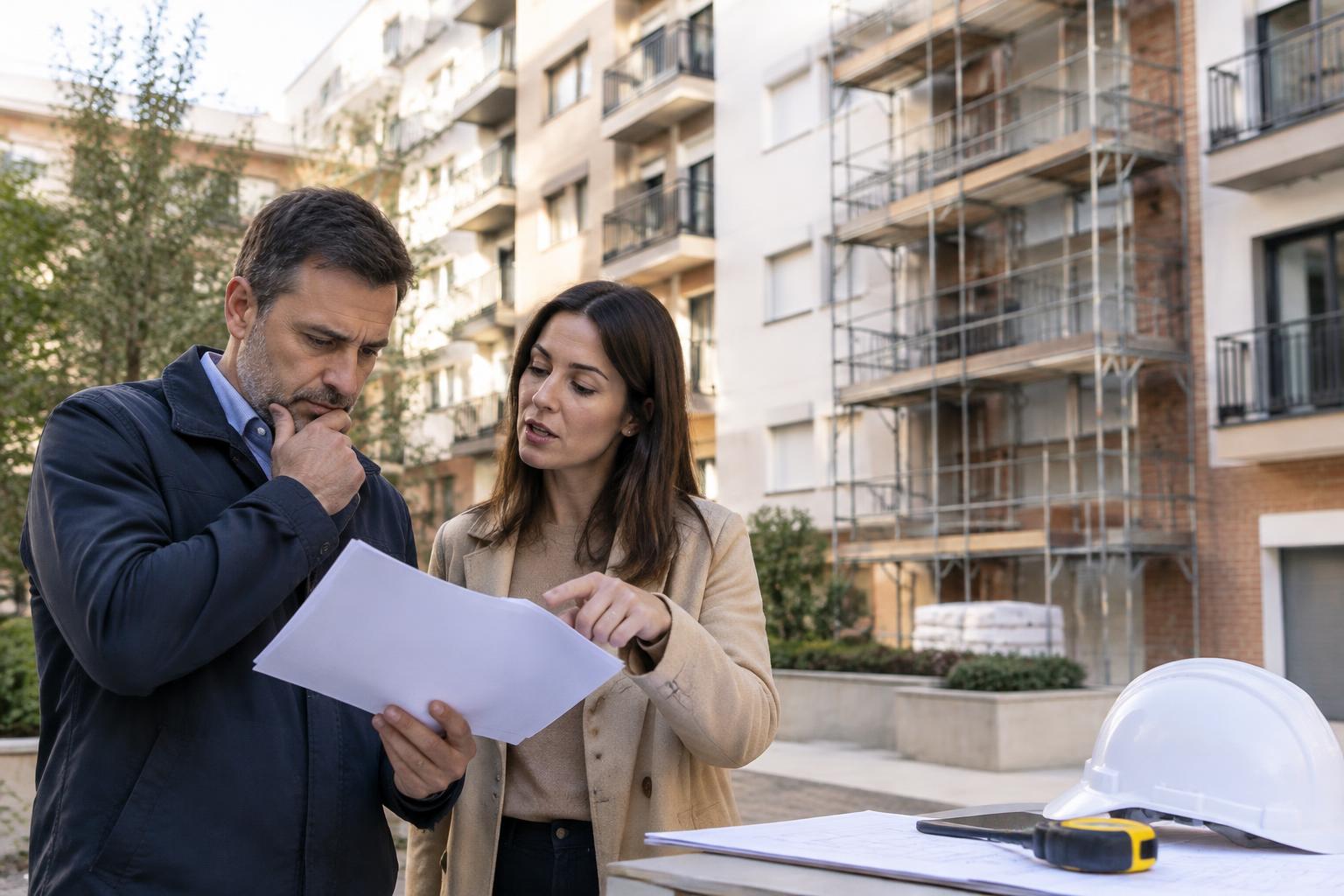
Energy efficiency works in the owners’ association: what the owner should check before voting
Before voting on energy efficiency works in your owners’ association, it is worth distinguishing which majority is required, what expenses can be passed on, what happens with the financing, and how the agreement should be recorded in the minutes.
What you should check before voting on energy efficiency works in your owners’ association
When an owners’ association is considering an energy efficiency project, the owner should not focus only on whether the work “seems like a good idea”. What matters is knowing **what agreement is being voted on, with what majority, what cost will be shared, whether there is financing and what effect it will have on the contribution corresponding to you**. The Horizontal Property Act distinguishes these actions from other communal works and sets out specific rules for approval and for passing on costs. In particular, article 17 regulates that works or the installation of renewable energy sources for common use may be agreed by certain majorities, and that the annual cost passed on, once public subsidies or grants have been deducted and any financing applied where applicable, cannot exceed the legal limit provided for in the Horizontal Property Act.
If you are an owner, this is the time to review the substance of the matter calmly. A well-drafted agreement avoids later disputes; an ambiguous agreement may leave doubts over who pays, when payment is due, and whether the work binds everyone equally or not.
1. What type of work is being proposed
Not every energy improvement is treated the same. In practice, it is worth separating three scenarios:
1. **Works necessary for conservation, safety, habitability or accessibility**.
2. **Energy efficiency improvements or the installation of common-use renewable energy systems**.
3. **Installations for private use** or those that directly benefit some owners.
The law provides, on the one hand, for works that may be mandatory and, on the other, for energy efficiency improvements that require the relevant majority. In addition, article 17 distinguishes between common and private installations, and regulates the passing on of costs differently. That is why, before voting, check whether the agreement refers to work on common elements, a new installation or an improvement that alters the building envelope, for example.
Practical advice: ask for the notice or the advance documentation to describe **what is to be installed, in which areas, what maintenance it will require and who will bear that maintenance**.
2. What majority may be required to approve it
One of the most common mistakes is to think that all energy works are approved in the same way. That is not the case. Article 17 regulates that:
- **Accessibility works** follow their own regime.
- **Energy efficiency improvement works or measures** and the installation of common-use renewable energy sources may be approved by **a simple majority of owners and quotas**, provided that the annual amount passed on, once public subsidies or grants have been deducted and financing applied, **does not exceed twelve months of ordinary common expenses**.
This means that, before supporting or rejecting the proposal, you should check two things:
1. Whether the association has correctly calculated the annual financial impact.
2. Whether that calculation already deducts grants or subsidies and takes account of financing, where applicable.
Common mistake: voting without knowing whether the proposal requires a simple majority, a qualified majority or unanimity. If the agreement is adopted with the wrong majority, it may be challengeable if the legal requirements are met.
3. What costs each owner may have to pay
The agreement should not simply state “it costs this much”. It must explain **how it is apportioned**. Here, it is worth checking:
- whether the expense is charged as a general common expense;
- whether there is a specific levy;
- whether payment will be made in one go or through financing;
- whether the association intends to pass on future conservation and maintenance costs;
- whether there are owners who did not vote in favour and, even so, are or are not bound.
The Horizontal Property Act establishes that, in certain cases, the association **may not pass on the cost of installation or adaptation, nor those arising from its subsequent conservation and maintenance, to owners who did not expressly vote in favour**, save for the legal exceptions. In addition, validly adopted agreements bind all owners where the law so provides.
Useful steps before voting:
1. Ask for the full quotation, not just a summary figure.
2. Check whether it includes the works, technical management, permits, maintenance and financing.
3. Verify how the levy is apportioned by coefficient or by another approved criterion.
4. Confirm whether any subsidies have already been applied for or granted.
4. What should appear in the minutes to avoid problems
The agreement is not properly closed if it appears only in a generic sentence. The minutes must clearly reflect what was approved, and the secretary must keep the association’s documentation. Moreover, if disputes arise later, documentary evidence will be decisive.
You should check that the minutes include at least:
1. The type of work approved.
2. The majority by which it is adopted.
3. The budget or financial criterion used.
4. The method of payment.
5. Whether financing is authorised.
6. Whether the agreement provides for later maintenance.
Practical advice: if you attend the meeting and do not agree with the resolution, make sure your vote is recorded and ask for it to be included in the minutes. If you do not attend, review the subsequent communication carefully.
5. When you may request an individual review of the case
The general guidance helps to understand the legal framework, but it does not replace an assessment of your specific association. For example, an energy works project in a small building is not the same as one in a large community, nor is a common installation the same as an action affecting several private elements.
There may also be nuances if:
- the building forms part of a property complex;
- there are statutes with specific rules;
- there is bank financing;
- the work coincides with other mandatory actions;
- there is a dispute over whether the installation is common or private.
If you need to assess your specific case, you can request an indicative property valuation at valoracion-vivienda-madrid or write to us via contact. The online valuation is indicative, includes a range and PDF report and, if you wish, can be completed with a visit.
The UBICASA office is at Calle Montesa 29, Madrid, with opening hours Monday to Friday from 10:00 to 15:00 and from 16:00 to 19:00.
If you would like to go further, read our related guide: Community of owners’ bylaws: what the owner of a flat should check.