
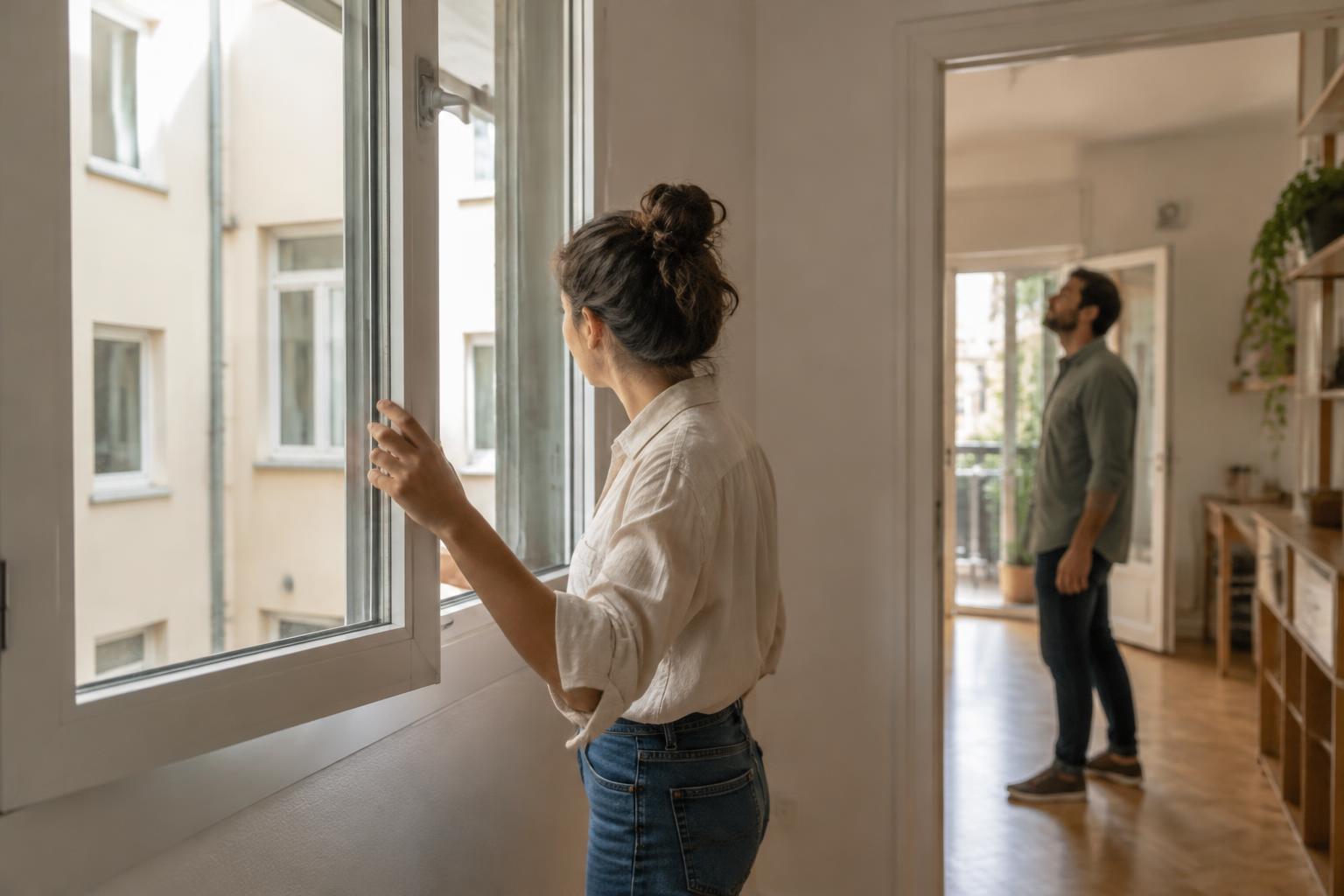
Interior or exterior flat: how to check light, ventilation and layout
Before you buy, do not stop at the label “interior” or “exterior”, or at well-framed photos. Learn how to check the real light, cross-ventilation and whether the layout works for your day-to-day life, with simple tests during the viewing and with the basic documentation it is worth asking for.
# Interior or exterior flat: how to check light, ventilation and layout
If you are thinking of buying a home, the difference between a flat being interior or exterior should not be judged solely by what the listing says. It also matters how light enters throughout the day, whether the air refreshes the rooms properly and whether the layout makes the property feel usable or, on the contrary, dark and poorly connected. The key is to check this during the viewing using practical criteria, not promises or photographs that may be misleading.
The verification date for this guide is 2 November 2026. The approach is deliberately specific: features and checks, not advertising labels or generic assessments.
1. What it really means for a flat to be interior or exterior
In practice, the “interior” or “exterior” label does not tell you everything you need to know. An exterior flat may have a good façade and, even so, part of the home may still feel dark if it faces a narrow courtyard or if its orientation reduces the amount of sunlight it receives. An interior flat, meanwhile, may be quieter and, in some cases, very bright if it faces a large or open courtyard.
What is useful is to separate three issues:
1. **Orientation and views**: it is not the same to face a wide street, a block courtyard, a small light well or an open inner courtyard.
2. **The depth of the property**: the longer and more compartmentalised it is, the less likely natural light is to reach the back properly.
3. **The relationship between openings and rooms**: a good home does not just have windows; it has useful windows in the rooms you need to use most during the day.
A common mistake is to assume that “exterior” automatically means bright and “interior” means dark. That is not always the case. What you should check is how the specific property behaves, not the label.
2. How to test natural light without being swayed by photos
Wide-angle, edited photographs or shots taken at a very favourable time can create a better impression than the home will give you in real life. That is why it is worth carrying out a physical, repeatable check.
### Practical steps during the viewing
1. **Do not go in looking only at the living room**. Walk through the entire property and see whether light reaches hallways, the kitchen, bathrooms and bedrooms.
2. **Look at the windows and what surrounds them**. Check whether there is another building very close by, dense trees, setbacks or narrow courtyards that reduce brightness.
3. **Check how deep each room is**. If a room has a window but the rest stays dark even during the day, the layout may be reducing the light.
4. **Ask for a second viewing at a different time of day**. The same property can seem very different in the morning, at midday or towards evening.
5. **Watch for reflections and shadows**. If you need artificial light on to see normally in the middle of the day, make a note of it.
It is also worth asking for basic documentation where appropriate. In property transactions in the Community of Madrid, the buyer can verify the legal status through the nota simple and, in addition, the owner must have the energy performance certificate and show it to the prospective buyer; this information helps to supplement the viewing with objective data .
3. How to check the property’s real ventilation
Ventilation is not just about opening a window. A well-ventilated home refreshes the air easily, prevents smells from becoming trapped and reduces the feeling of being shut in. During a viewing, you can carry out several simple checks.
### What you should review
1. **Whether there is cross-ventilation**: see if there are openings on different façades or on opposite sides of the property.
2. **Whether the air moves between rooms**: open internal doors and check whether the flow passes through the home or whether everything remains “trapped” in one area.
3. **Whether the bathrooms and kitchen have a reasonable ventilation solution**: a kitchen or bathroom without proper ventilation usually worsens day-to-day comfort.
4. **Whether there are blind rooms**: a room without natural ventilation may be useful for certain purposes, but you should know that before buying.
5. **Whether there are indirect signs of poor air renewal**: condensation, persistent smells or damaged paintwork may be warning signs.
### Common mistake
Do not confuse a brief draught when doors are opened with good ventilation throughout the home. Sometimes the air only moves because of the viewing itself. What matters is the actual ability to refresh the air in everyday use.
4. Layout: the third filter that can change the whole purchase
A home may have acceptable light and yet be poorly laid out. Or the other way round: a well-planned layout can partly make up for more limited light. That is why the layout should be assessed alongside light and ventilation, not afterwards.
Ask yourself the following:
1. **Are the day and night areas properly separated?**
2. **Are there excessive corridors that waste usable space?**
3. **Are the rooms a sensible size for the use you need?**
4. **Is the kitchen conveniently connected to the entrance and the living room?**
5. **Are there odd routes, unnecessary turns or rooms that can only be accessed by going through another room?**
If the property seems “larger” in photos than in person, there is usually an issue with scale, circulation or framing. Pay attention to the real sense of use: where you would put a table, how you would move around with shopping bags, whether wardrobes and doors open properly, or whether a standard bed would still leave enough space.
5. What to do before you decide and what you should not accept without checking
Before making an offer or entering into negotiations, it is worth approaching the viewing with a basic method.
### Practical actions
1. **Bring basic measurements or note down the square metres of each room**.
2. **Take your own photos and compare them later in peace**.
3. **Write down where the light comes in and what time of day you visited**.
4. **Ask which rooms face outside and which face a courtyard**.
5. **Ask to review the home’s basic documentation** if you are going to move forward with the purchase.
### Do not accept without checking
- Claims such as “it is very bright all day” without checking it for yourself.
- Photos that do not show windows, courtyards or the true depth of the property.
- The idea that a good reconfiguration can “be sorted out later” if you already know major works will be needed.
- The assumption that an exterior property will automatically be better than an interior one.
If, after the viewing, you would like to cross-check a preliminary assessment of the property or ask for help interpreting whether the layout fits what you are looking for, you can do so at /valoracion-vivienda-madrid. And if you would rather discuss your specific case before going any further, you can write to /contacto.
In short, buying an interior or exterior flat well means looking beyond the listing. Light, ventilation and layout are not judged by instinct or by an attractive photo: they are checked, compared and, if necessary, viewed again. That is the most sensible way to avoid a purchase that seemed right on paper but did not work in daily use.